
1. Overview
Name
- Observation Mechanics
Intent
Maintaining the balance of attention by using game mechanics dependent on the surrounding location encouraging players attention away from device and towards the space itself.
2. Target
Problem
Locative games create interactive experiences in places of heritage and natural beauty. However, at times they can capture the players attention on the device with the experience – reading text and playing games – to the exclusion of the surrounding location itself.
Context
The user is playing a locative game at a heritage site where there is tension between attention on screen and location.
Forces
The success of this pattern depends on the wider pattern of play in the game and the location itself – sites with striking points of interest and games with direct diegetic references are will leverage this pattern with more ease.
Consequences
Weaknesses:
- Splitting player attention between phone and environment if done poorly may result in the player missing key elements in either.
Strengths:
- By incorporating the location itself into mechanics in the game the locative experience can serve as a means of direct engagement with the site.
- By making direct use of the surroundings the locative game may take advantage of one of its key assets: the heritage or natural beauty of its location.
3. Application
Solution
Locative games need not have only traditional mechanics focused solely on the screen (such as traditional character dialogue, text, puzzles, and media). Mechanics may also encourage the player to observe and notice their surroundings and location, and, as such, engage more with place beyond the screen. We identify 3 mechanisms of achieving this: creative play, diegetic challenges, and visual augmented reality.
Creative play mechanics encourage the player to create within the game in a way connected to their location. By encouraging the player to draw what they see, or design an artefact based on the location, the game play also encourages the player to observe and otherwise notice their surroundings with a more attentive eye. Diegetic challenges are puzzles or game challenges the solution for which is based in the environment bringing the location itself into the game – in the spirit of classical treasure hunts the player might be challenged to answer a question about their space or solve a challenge with information hidden in plain sight – again encouraging observation of their surroundings. Finally, perhaps the most common form of observant mechanic is the use of visual augmented reality to layer game mechanics such as characters or puzzles onto a devices camera to place them in the real-world making observation of the screen observation of location as well.
Rationale
In creating play within space as a means of engagement with heritage sites we can strengthen that engagement by not merely playing on location but playing with location – making the site directly part of the play..
Implementation Details
Suggestions:
- Creative play: using creativity as a means to play with the site by having the player build, make, or create items based on the site and within the theme of the story.
- Diegetic challenges: tie the solutions to gameplay challenges to observing the site itself to bring the player off the screen.
- Visual augmented reality: make observing the screen also observing the site by layering gameplay on to the camera and as such the location.
Issues:
- Creative mechanics can help the player engage with the aesthetics and themes of the site but they will not necessarily engage with the details of heritage history and learning
- Diegetic challenges: are dependent on objects within the area that are clearly identifiable and can factor into game challenges. Open spaces with few landmarks may find this form of design difficult.
- Visual augmented reality can create spectacle and, as such, the attention may be more on the virtual augmented content than the space itself. It is also dependent on technology that may fail or be unreliable in some cases.
Pitfalls:
- Using observant mechanics that don’t resonate with the project site and goals
- AR technology may be unreliable in some contexts.
Impact on Balance of Attention
By building the act of observing into play itself the designer can balance the players attention between the screen and the location. This can leverage one of the greatest assets of locative games in the place itself, as well as maximizing the experiences ability to engage players with the location.
The first two methods achieve this through mechanics that encourage the player to notice their surroundings – either by searching for inspiration in creative mechanics, or searching for answers in diagetic challenges. The creative approach is much more free form and, as such, more flexible – often allowing players to engage with the site and travel around it as they see fit while being encouraged to view the aesthetics of the site. Diegetic challenges are more targeted often with specific questions or puzzles based on specific places on site – this is less flexible but also gives the designer more control if the seek to guide the eye of the player to more particular locations.
The final method achieves this through blending observation between the screen and the space by layering the experience on the camera with which to view the space. This is not so much balancing attention as avoiding the need to balance by having the player attend to both simultaneously. This can be a means of delivering screen intensive gameplay (such as character interactions or item puzzles) while still delivering on observing the space. But the spectacle of the AR tech may itself act as a distraction and with the place as backdrop it maybe be limited in grasping the players attention.
Example
As part of CS2 and the Avebury Adventures Anthology designers experimented with a range of observant mechanics.
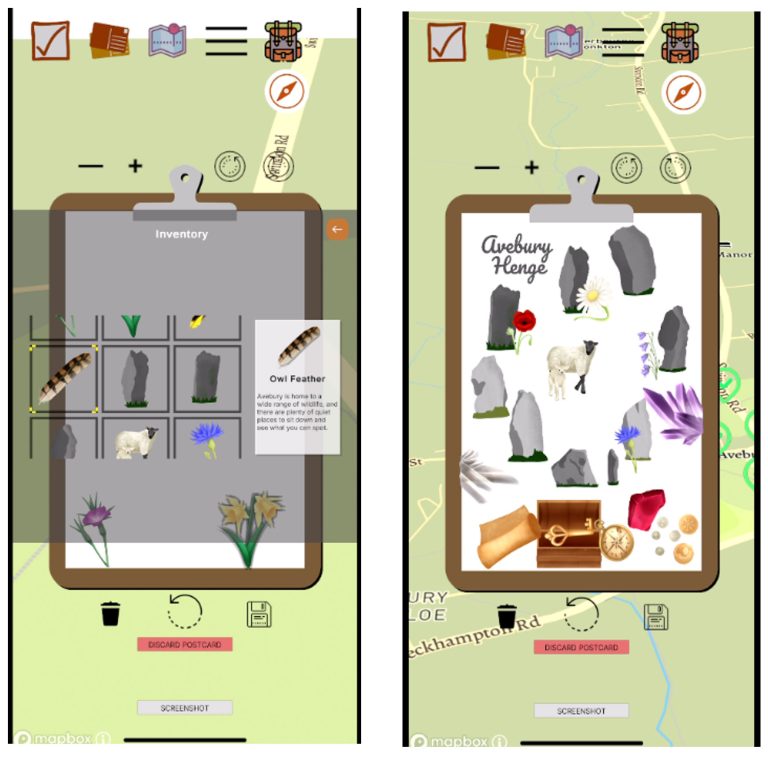
Imagining Avebury was one of several creative games that saw the player creating a post card for the Avebury site. Rather than collecting items of clues players wandered the site collecting inspiration which took the form of stickers and graphics they could use as part of their postcard. When ready players could then sit and use a canvas interface of drawing tools, alongside their stickers, to create a postcard for their day.
The experience was very positive reviewed by players who both enjoyed the creativity of the game but also the novelty of this way of engaging with the heritage site. The gathering of inspiration/sticks took players on a walk around the site where they could experience a range or locations but then the act of creation also encouraged them to spend time observing the site in order to inform that creation.
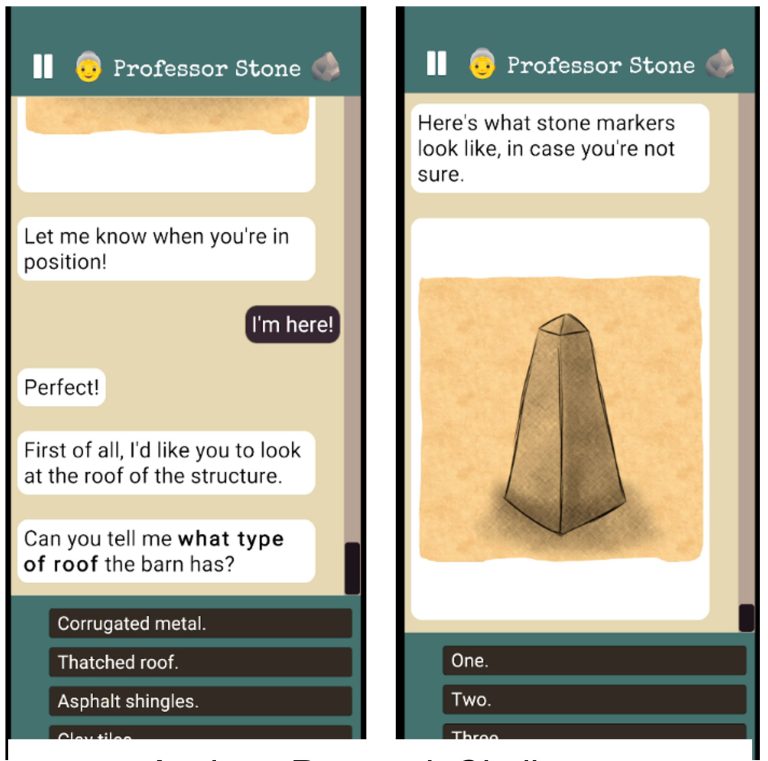
The Avebury Research challenge was a more traditional educational game that discussed the history of the Avebury location. Trying to mimic the form factor of the phone it is played on it takes place as a text chat conversation with an offsite professor conducting research. However, in order to move the players’ attention away from the screen the game often asks the player to answer or report on aspects within the site itself such as the number of stones or what is present on the site.
This is an example of how a more traditional historical serious game can move the attention of the player away from the device and towards their surroundings by making specific diegetic references to the site itself within its challenges and gameplay – encouraging the players to notice things within their surroundings in order to progress.
4. Supplementary Information
Biography
Version 1.0 (19/3/26) – Initial pattern based on close reading analysis. Charlie Hargood (BU)
Discussion
Rather than a specific singular pattern, this is a classification of smaller patterns in terms of how mechanics can be built into site observation. The central theme here is that viewing the site can be a form of play but designers have a range of options for how to achieve this.
Team
- Charlie Hargood – Principal Investigator
- Jack Brett – Researcher
- Bob Rimington – Researcher
Partners

Related Resources
-
Directional Audio Navigation Cues
1. Overview Pattern Level: Sub-pattern of Audio-First Dual-Mode NavigationPrimary Phase: GuidingOne-line Summary: A navigation mechanism that plays periodic spatially positioned musical cues derived from each character’s theme, giving players directional…
-
Character-Triggered Layer Transition
1. Overview Pattern Level: High-levelPrimary Phase: Cross-phaseOne-line Summary: A layer switching mechanism that transitions the player to a different content layer when they complete an encounter with a designated portal…
-
Orientation-Based Combat
1. Overview Pattern Level: High-level Primary Phase: PresentingOne-line Summary: A challenge mechanic that uses head orientation tracking to let players evade spatially positioned threats, turning the same sensing infrastructure used for…
-
Head-Directed Target Locking
1. Overview Pattern Level: Sub-pattern of Audio-First Dual-Mode NavigationPrimary Phase: GuidingOne-line Summary: A target selection mechanism that locks onto a navigation target when the player maintains head orientation toward it…
-
Progressive Proximity Audio Zones
1. Overview Pattern Level: Sub-pattern of Audio-First Dual-Mode NavigationPrimary Phase: PresentingOne-line Summary: A zone-based audio system that transitions players from silence through character music to narrative dialogue as they physically…
-
Audio-First Dual-Mode Navigation
1. Overview Pattern Level: High-levelPrimary Phase: Cross-phaseOne-line Summary: A navigation system that automatically separates exploration and content delivery into two distinct modes, preventing navigation audio and character audio from competing…


