
1. Overview
Name
- Variable Location Link Strength
Intent
For the designer to achieve different navigational experiences as desired by weakening or strengthening the link between play and location.
2. Target
Problem
Content within the game is linked to locations/context and the player needs both navigation to that location or context while still achieving the desired player experience.
Context
The user is on site and playing a locative game seeking content that is designed for engagement in a specific place or context. They are using a mobile device capable of location sensing.
Forces
The success of this pattern depends on how well the strength of the location link is tied to both accessibility and the desired player experience.
Consequences
Weaknesses:
- Tension between usability and desired experience means that a weaker link between location and content may leave a player feeling unguided or ambiguous in terms of what they should be doing.
- Stronger location links may come with technical costs and rely upon technologies that can be inconsistent.
Strengths:
- Gives the designer flexibility in terms of guidance and location linking without having to follow a single paradigm of locative content.
3. Application
Solution
Content can be linked to location in variable manners – this link is made up of both location detection (triggering content based on player location) and location guidance (information given to a player to instruct them in traversal). The design of the location link can be varied in both these regards.
We describe the location detection component of the link as either a “hard location” or “soft location”. Hard locative experiences require travel to a specific location that is detected using sensors – such as GPS, computer vision anchors, Bluetooth connection, or scanning QR codes. Soft locative experiences are locative without sensors and ask that a player either self-report when they have arrived at a location, travel to an ambiguous or nonspecific location that they self-report arrival at, or do not travel at all but rather bring locative content to them.
Similarly, guidance to the location can also be varied. Methods of strengthening guidance include maps (both with and without destination pins, and with and without player tracking), textual instruction, audio cues on direction and proximity, textual descriptions of where to travel, and visual depictions and cues of what to look for. Stronger links will use more of these, weaker links less.
Rationale
Locative play demands a link between game content and location but how we construct that link impacts the degree to which it is connected and the experience of play.
Implementation Details
Suggestions:
- Hard location detectors:
- GPS
- QR Code
- Bluetooth
- Soft location detectors:
- Self-report (specific location, or type of location)
- Location content without travel
- Strong guidance
- Maps with destination pins and player tracking
- AR beacons
- Moderate guidance
- Directional guidance
- Audio cues
- Compasses
- Visual depiction of destination
- Directional guidance
- Weak guidance
Issues:
- Technology location detection may fail and comes with implementation cost
- Technology reliability varies by location
- Guidance accessibility varies by user
Pitfalls:
- Using strong links with unreliable technology
- Using weak links leaving users unguided and unsure
Impact on Player Experience
A location link can be strengthened using hard location detection and multiple layered specific guidance tools, it can be weakened by adopting soft location detection and minimal ambiguous guidance. Strengthening or weakening a location link changes the player experience.
Strong links keep the player feeling in control, aid diegetic reference to context, and avoid players feeling unsure. But they are also brittle (if the player gets it wrong or can’t make it work the experience ends), reliant on sensor technology, and reliant on player interpretation of guidance (which may be harder for younger audiences.
Weaker links are flexible (without the need for specific location the player can progress regardless of navigation), have low technology requirements, and make less navigation demands of the player. But they can leave players questioning if the experience is working properly, are less precise and as such compromise diegetic references, and may see players feeling unsure of what they are supposed to be doing.
Designers can dial in location link strength to match the target audience and gameplay.
Example
As part of CS2 and the Avebury Adventures Anthology designers experimented with a range of different strengths of location linking.
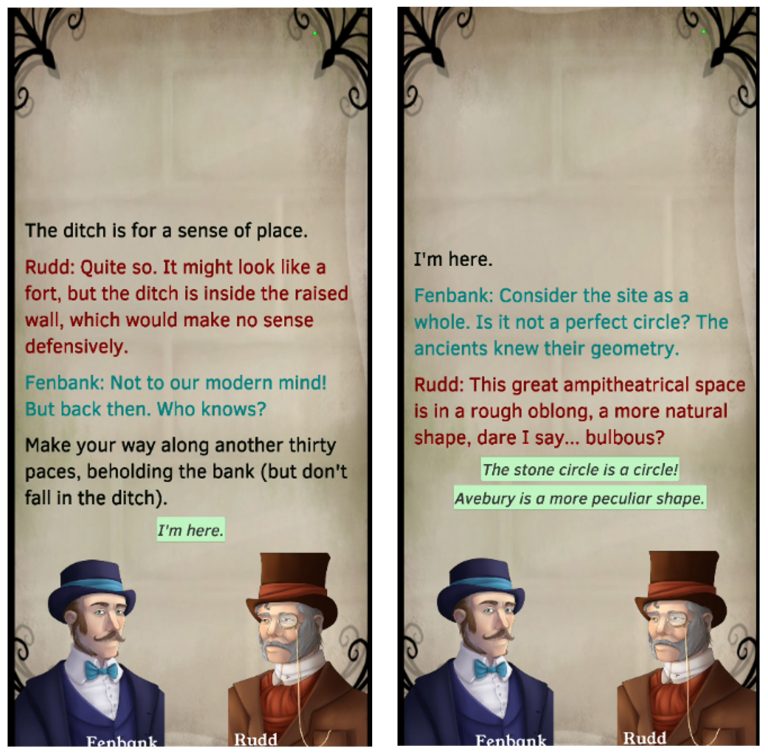
The Stone Truth adopts a very weak form of location linking – using soft locations and self-report for arrival while guiding users using vague (sometimes whimsical) textual destinations.
The purpose here is to detach the player from the stress of worrying if they are in exactly the right spot of the circle and instead walk around it at their own freedom and pace thinking about the overall location and theories raised by the characters in the game.
This kept the technical barriers and dependencies for the game low, and players enjoyed being able to pick up and play the game wherever they were in the circle. However, some players, expecting more of a hard location approach as shown in other games, were left a bit confused and unsure if they were playing it properly and if they were in the right place.
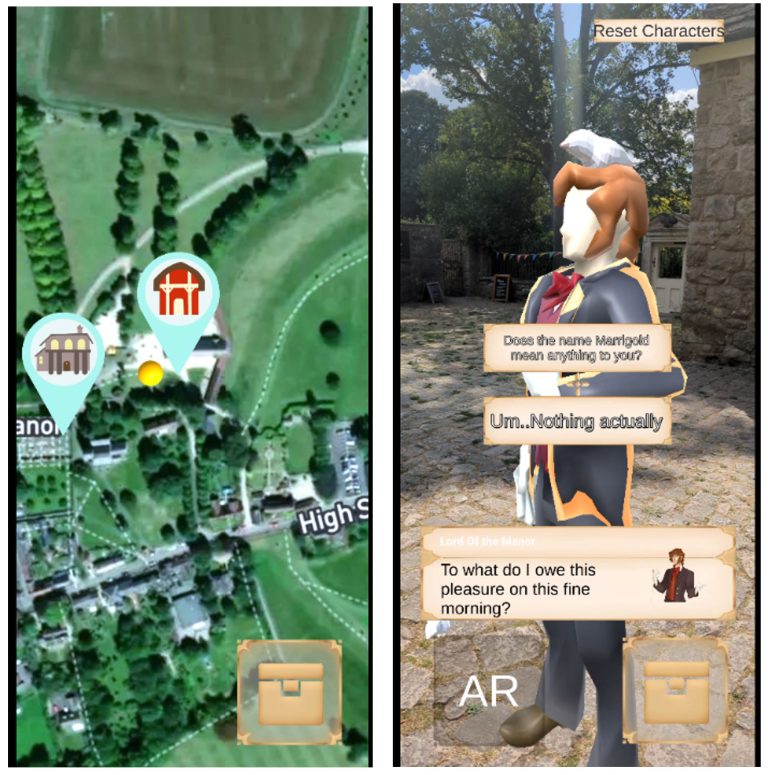
Echoes of Avebury adopts a much stronger form of location linking – with content tied to both GPS location and AR visual location anchors – its guidance is also stronger with full maps with location pins and player tracking.
The purpose here was to create content in very specific locations that could make diegetic reference to particular parts of the Avebury site (such as the dovecote which includes a dove-related puzzle) while also making the investigation narrative feel deliberate and purposeful.
This created a very controlled experience that was able to directly bring the players’ context into the experience while also leveraging the spectacle of AR content. However, the experience was quite brittle and if there were technological issues on players’ phones with GPS or cameras, or they struggled to find the exact spot a scene would take place, it led to player frustration and more time thinking about the technology rather than being immersed in the gameplay.
4. Supplementary Information
Biography
Version 1.0 (19/3/26) – Initial pattern based on close reading analysis. Charlie Hargood (BU)
Discussion
Rather than a specific singular pattern this is a classification of micro patterns in terms of how location links are built using combinations of detection and guidance. However, the composition of these smaller elements into variable link strength is what created design impact.
Team
- Charlie Hargood – Principal Investigator
- Jack Brett – Researcher
- Bob Rimington – Researcher
Partners

Related Resources
-
Directional Audio Navigation Cues
1. Overview Pattern Level: Sub-pattern of Audio-First Dual-Mode NavigationPrimary Phase: GuidingOne-line Summary: A navigation mechanism that plays periodic spatially positioned musical cues derived from each character’s theme, giving players directional…
-
Character-Triggered Layer Transition
1. Overview Pattern Level: High-levelPrimary Phase: Cross-phaseOne-line Summary: A layer switching mechanism that transitions the player to a different content layer when they complete an encounter with a designated portal…
-
Orientation-Based Combat
1. Overview Pattern Level: High-level Primary Phase: PresentingOne-line Summary: A challenge mechanic that uses head orientation tracking to let players evade spatially positioned threats, turning the same sensing infrastructure used for…
-
Head-Directed Target Locking
1. Overview Pattern Level: Sub-pattern of Audio-First Dual-Mode NavigationPrimary Phase: GuidingOne-line Summary: A target selection mechanism that locks onto a navigation target when the player maintains head orientation toward it…
-
Progressive Proximity Audio Zones
1. Overview Pattern Level: Sub-pattern of Audio-First Dual-Mode NavigationPrimary Phase: PresentingOne-line Summary: A zone-based audio system that transitions players from silence through character music to narrative dialogue as they physically…
-
Audio-First Dual-Mode Navigation
1. Overview Pattern Level: High-levelPrimary Phase: Cross-phaseOne-line Summary: A navigation system that automatically separates exploration and content delivery into two distinct modes, preventing navigation audio and character audio from competing…


