
1. Overview
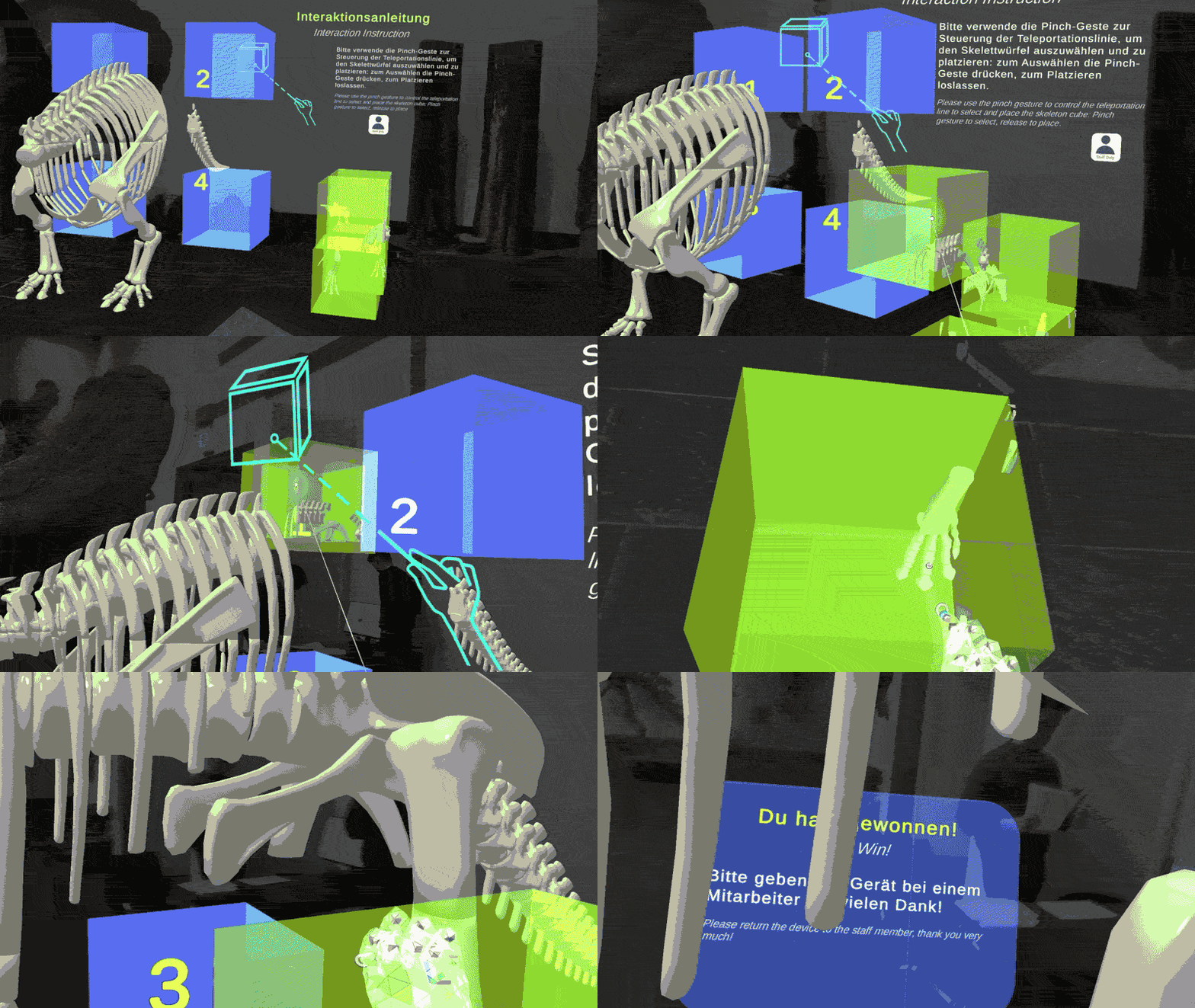
A puzzle-like interaction where visitors reassemble an exhibit in AR.
Name
- AR Exhibit Reassembler
Intent
Enable visitors to virtually reconstruct missing artifact components through an interactive 3D puzzle, deepening comprehension of the whole form and its significance.
2. Target
Problem
When only partial physical artifacts are on display, visitors struggle to grasp the complete structure and relationships between parts.
Context
- Exhibits with missing components (fossils, machinery, relics).
- Digital reconstructions available for the absent pieces.
- Desire to engage users in an active, hands-on learning process.
Use When
- Visitors encounter artifacts with substantial missing elements.
- The goal is to teach overall structure via participatory assembly.
Forces
- Engagement vs. Complexity: Balancing puzzle difficulty to avoid frustration.
- Accuracy vs. Playfulness: Ensuring reconstructions are correct while remaining fun.
- Spatial Registration: Aligning virtual pieces precisely with the physical artifact.
- Feedback Responsiveness: Providing timely confirmation to sustain motivation.
Consequences
Weaknesses:
- Poor tracking or misplacements can cause confusion; overly simple puzzles may feel trivial.
Strengths:
- Active learning, improved spatial understanding, memorable interaction.
3. Application
Game Mechanics
- Type: Jigsaw puzzle
- Piece Matching: Identify and align puzzle pieces based onshape, color, or patterns.
- Spatial Arrangement: Determine correct spatial placement of pieces within the layout.
- Pattern Recognition: Identify connections using visual cues.
- Trial and Error: Experiment with combinations to find correct fits.
- Progression Feedback: Provide a sense of progress and achievement.
- Challenge Balancing: Adjust difficulty by varying the complexity of components.
Solution
1. Jigsaw-Puzzle Mechanic
- Spawn interactive 3D fragments representing the missing parts.
- Allow visitors to drag or gesture-match edges/textures to snap pieces into place on the physical artifact.
2. Progression Feedback
- On correct placement, play a glow animation on the piece and an encouraging audio cue.
- Update a visible completion meter (e.g., “3 of 8 pieces assembled”).
3. Adaptive Challenge
- Start with boundary or high-contrast pieces for early confidence.
- Introduce subtler shapes or mirrored fragments as users progress, adapting based on placement speed and errors.
4. Guidance & Tutorial (Optional)
- Highlight an initial docking region with a pulsing indicator.
- Play a brief voice-over or display on-screen instructions explaining controls and objectives.
5. Narrative Enhancements (Optional)
- As sections assemble, trigger contextual facts (e.g., “This vertebra supported the spinal cord”) via text and audio to weave learning into the flow.
Rationale
- Transforming passive viewing into active assembly engages spatial reasoning and contextualizes individual components within the artifact’s holistic form, reinforcing educational outcomes.
Design Parameters
- Piece Count: 4–8 fragments to balance challenge and completion time
- Snap Tolerance: 0.2–0.5 m positional threshold, 10-30° rotational allowance
- Feedback Delay: ≤ 1 s between placement and confirmation
- Completion Meter: Updated immediately upon each placement
Example
At a fossil exhibit where only part of the original exhibit is physically preserved, visitors launch an AR puzzle that presents the missing bones as virtual fragments. They pick up and position these pieces one by one, aligning them with the physical remains until they snap into place. Each correct placement triggers a short visual and audio confirmation, while a completion indicator shows overall progress. Through this process, visitors gradually understand the full structure of the exhibit rather than only viewing isolated remains.
Notes
This pattern transforms incomplete physical remains into a hands-on, completion-driven experience that reinforces structural understanding and sustains visitor motivation.
Related Patterns:
- Avatar Guide: Avatar Guide can lead visitors to the reconstruction station or point of interest before the puzzle interaction begins.
- Step-In Circle: Step-In Circle can serve as the activation pattern that launches the reassembly task once visitors arrive at the exhibit.
- Sequential Explanation: A short sequential explanation may precede the puzzle to introduce the missing parts, explain the task, or provide scientific background.
- Labelling: Labelling can complement the puzzle by identifying individual fragments or explaining the role of reconstructed components after they are assembled.
Team
- Yu Liu – Researcher and AR Designer/Developer
- Dr. Ulrike Spierling – Principal Investigator
Partners

Related Resources
-
Directional Audio Navigation Cues
1. Overview Pattern Level: Sub-pattern of Audio-First Dual-Mode NavigationPrimary Phase: GuidingOne-line Summary: A navigation mechanism that plays periodic spatially positioned musical cues derived from each character’s theme, giving players directional…
-
Character-Triggered Layer Transition
1. Overview Pattern Level: High-levelPrimary Phase: Cross-phaseOne-line Summary: A layer switching mechanism that transitions the player to a different content layer when they complete an encounter with a designated portal…
-
Orientation-Based Combat
1. Overview Pattern Level: High-level Primary Phase: PresentingOne-line Summary: A challenge mechanic that uses head orientation tracking to let players evade spatially positioned threats, turning the same sensing infrastructure used for…
-
Head-Directed Target Locking
1. Overview Pattern Level: Sub-pattern of Audio-First Dual-Mode NavigationPrimary Phase: GuidingOne-line Summary: A target selection mechanism that locks onto a navigation target when the player maintains head orientation toward it…
-
Progressive Proximity Audio Zones
1. Overview Pattern Level: Sub-pattern of Audio-First Dual-Mode NavigationPrimary Phase: PresentingOne-line Summary: A zone-based audio system that transitions players from silence through character music to narrative dialogue as they physically…
-
Audio-First Dual-Mode Navigation
1. Overview Pattern Level: High-levelPrimary Phase: Cross-phaseOne-line Summary: A navigation system that automatically separates exploration and content delivery into two distinct modes, preventing navigation audio and character audio from competing…


