
1. Overview
Name
- Relational Interactivity in Museums
Intent
To design digital heritage experiences that treat interactivity not as a private exchange between one visitor and one system, but as a relational field among humans, nonhumans, collections, environments, and technologies. The pattern supports more-than-human engagement by making nonhuman agencies perceptible, situating digital content in material museum ecologies, and enabling ethical, affective, and social participation.
2. Target
Problem
Many museum interactive experiences still reproduce a form of configured interactivity: tightly scripted, individualized, system-led encounters in which the visitor operates a device but does not enter into a meaningful relation with the museum’s wider ecology. In these cases, nonhuman entities remain objects of explanation rather than participants in meaning-making, and the system itself becomes the center of attention.
This is especially limiting in natural history and environmental heritage settings, where the design goal is not only to transmit facts, but to foster ecological attunement, reciprocity, care, and reflection across human and more-than-human worlds.
Context
Use this pattern when:
- The museum or heritage site wishes to foreground animals, plants, habitats, geological entities, or ecological processes as active presences.
- The experience takes place in a hybrid museological space, where collections, architecture, digital media, and environmental context already intersect.
- The aim is to support multisensory, social, reflective, or place-based engagement, rather than mere information access.
- Designers want to connect digital mediation to specific specimens, exhibits, gardens, habitats, or routes.
Typical settings include natural history museums, botanical gardens, science centers, landscape interpretation spaces, eco-museums, outdoor heritage trails, and mixed indoor-outdoor exhibition ecologies.
Forces
The success of the pattern depends on balancing the following forces:
- Shared perceptual access: the experience should be visible, audible, and interpretable by more than one visitor, not hidden inside overly private interfaces.
- Distributed agency: nonhumans should appear as co-participants with their own constraints, viewpoints, or traces, rather than as decorative wrappers for human-centred content.
- Situated anchoring: digital content must remain tethered to physical matter, museum space, and local ecology.
- Temporal depth: the interaction should allow for slowness, revisiting, unfolding consequences, or ecological timescales, rather than only fast-response loops.
- Ethical and affective transparency: visitors should be able to sense not only wonder, but also care, consequence, discomfort, responsibility, and the mediated nature of the representation.
- Social legibility: co-present visitors should be able to observe, interpret, and contribute to the encounter.
- Narrative richness without over-scripting: the system must avoid thin, linear, or purely didactic interactions that collapse back into principal-user behavior.
Consequences
Weaknesses:
- More complex to design and evaluate than standard kiosk-style interactives.
- It can be undermined by poor contextual integration, thin storytelling, buggy interaction, or interface friction.
- Risks anthropomorphism or a tokenistic “nonhuman voice” if representation is not carefully grounded.
- May require more curatorial coordination across space, media, and interpretation layers.
- Success may be harder to measure with conventional usability metrics alone.
Strengths:
- Encourages visitors to perceive nonhumans as co-present and addressable.
- Produces stronger ecological attunement through co-presence, place, affect, and story.
- Supports collaborative meaning-making and group interpretation.
- Repositions digital systems as relational infrastructures rather than informational terminals.
- Better aligns museum design with posthuman, ecological, and multispecies heritage approaches.
3. Application
Solution
Design the digital experience as a situated, shared, and polyphonic encounter in which:
- A nonhuman presence becomes perceptible through voice, behavior, perspective, trace, or ecological consequence;
- The interaction remains anchored to specific material surroundings, specimens, habitats, or environmental conditions;
- Visitors are invited to participate with others in interpretation, care, or co-storying;
- The system makes room for ambiguity, reciprocity, and ethical reflection, rather than only correct answers or efficient completion.
In practical terms, this means designing with six criteria in mind:
- shared perceptual access;
- distributed agency;
- situated anchoring;
- temporal depth;
- ethical-affective transparency;
- social legibility.
Rationale
More-than-human engagement becomes strongest when visitors do not merely “use” a system, but enter into a relation involving bodies, place, stories, collections, and ecological actors. As explored in our work during the LoGa Culture project, visitors reported the richest experiences when nonhumans appeared as co-participants, when the experience was grounded in the physical site, when narratives enabled perspective-taking, and when ethical implications surfaced through interaction.
In contrast, relationality weakened when narratives were shallow, responses repetitive, or mediation displaced attention from the museum ecology toward the technology itself.
Implementation Details
Suggestions:
- Use direct address, first-person narration, conversational framing, or ecological traces to let nonhuman entities “speak” without reducing them to mascots.
- Anchor digital content to actual specimens, garden features, habitats, routes, sounds, or display cases.
- Favor shared displays, group-facing audio, mirrored visuals, collaborative surfaces, or co-located tasks over isolated personal interaction.
- Use polyphonic or branching story structures that let visitors negotiate viewpoints rather than consume a single authorized narrative.
- Build in moments of reflection, consequence, and return so the encounter unfolds over time rather than ending at first interaction.
- Make the mediation visible: explain where a nonhuman “voice” comes from, what sources or data support it, and what the limits of representation are.
Issues:
- Nonhuman representation may become too human-like or too didactic.
- AR/VR can either enrich place or displace attention away from the physical museum.
- Conversational systems can feel meaningful at first, but quickly become repetitive if not sufficiently grounded and responsive.
- Group participation can be unintentionally blocked by headset use, narrow viewing angles, or single-user interaction flow.
Pitfalls:
- Treating “interactivity” as button pressing or question-answer exchange.
- Hiding the whole experience inside an individual screen or headset with no shared access.
- Using a nonhuman voice only as an aesthetic wrapper for a standard educational script.
- Over-simplifying ecological relations into moralistic binaries.
- Designing for novelty rather than durable relational meaning.
Impact on…
Visitors
Supports empathy, curiosity, co-presence, perspective-taking, and ethical reflection. Visitors are more likely to feel with and through ecological others, rather than only learn about them.
Museum interpretation
Shifts interpretation from static explanation toward ecological world-building, relational storytelling, and multispecies participation.
Curatorial practice
Requires tighter integration between content, exhibit layout, atmosphere, material context, and digital mediation. Encourages curators to treat the museum space itself as part of the interaction.
Institutional role
Positions the museum as a relational infrastructure for ecological imagination, care, and accountability, rather than only a repository of knowledge.
Example
Madeira CS3 uses this design pattern as part of its more-than-human museum ecology in several complementary ways:
- ChatSpecies applies the pattern by giving taxidermied specimens a conversational presence, allowing visitors to engage them as more-than-human interlocutors while remaining physically close to the displayed species. This combines nonhuman voice, material anchoring, and visitor-driven exploration.
- Critter Chorus applies it through a multisensory narrative installation where human and monk seal characters share narrative presence, and visitor choices reveal ecological consequences, supporting ethical reflection and shared agency.
- RoPPi applies it through collaborative story-making, where players inhabit human and nonhuman characters and co-create place-based ecological narratives across Madeira.
- Critter Connect applies the pattern through the exploration of communicating through and with nonhuman voices, situated anchoring, bodily movement, and ethical-affective considerations.
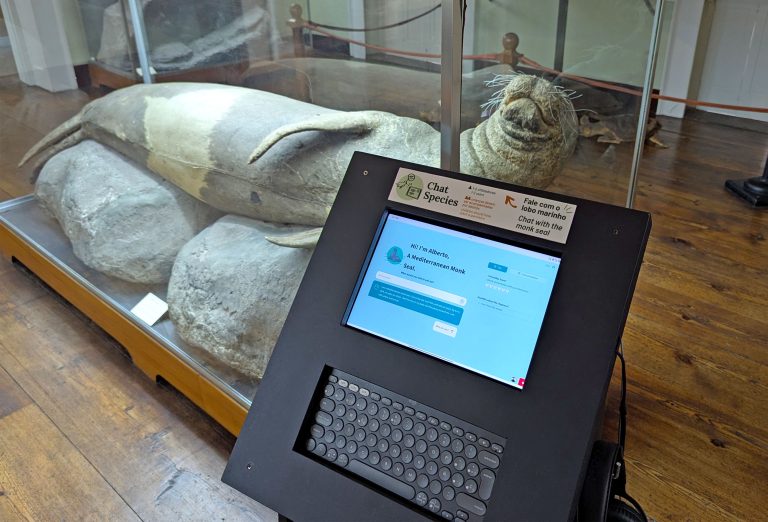 ChatSpecies
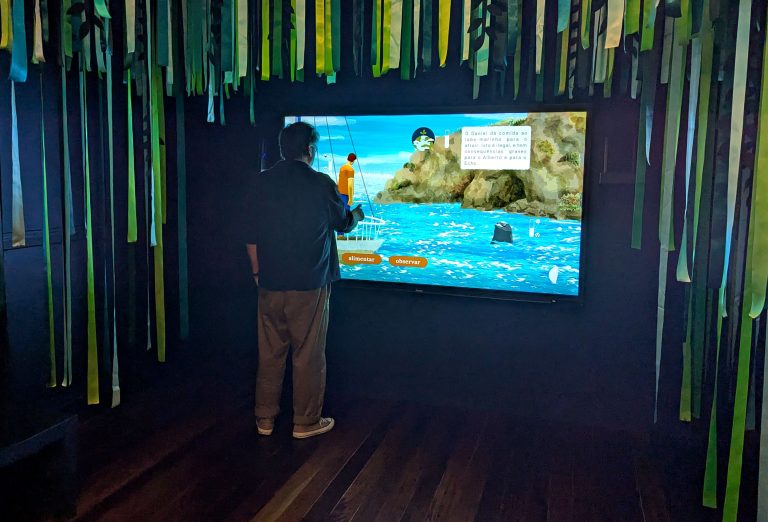 Critter Chorus
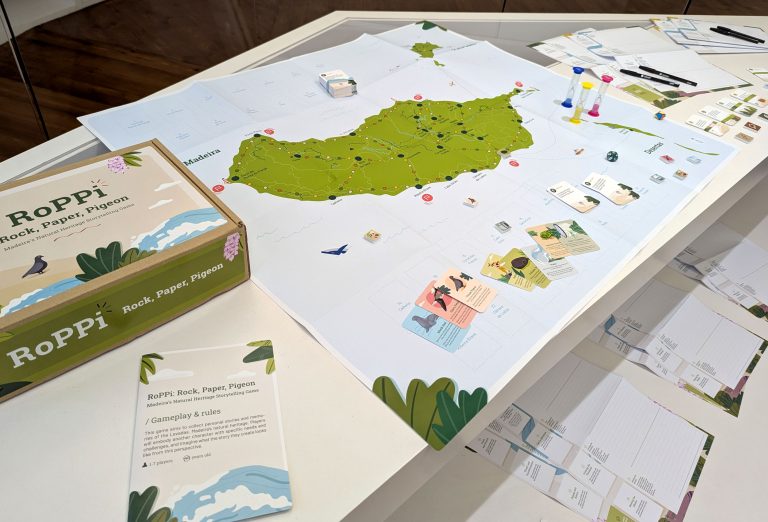 RoPPi
RoPPi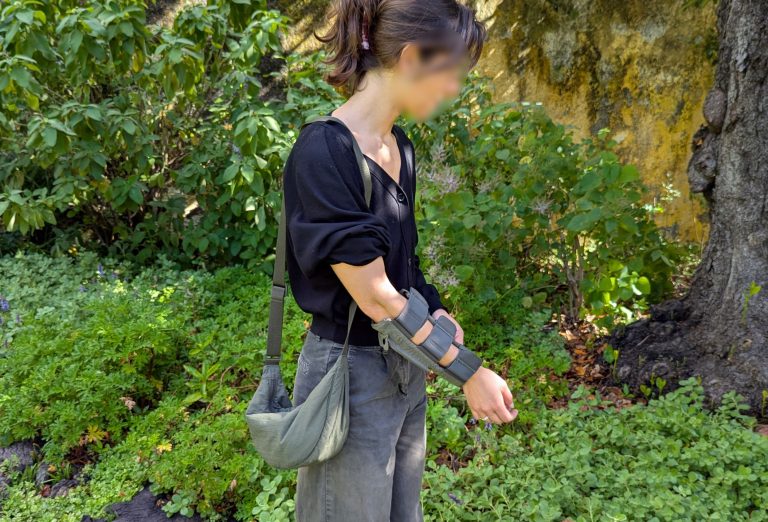 Critter Connect
Furthermore, a collaborative study with CS5 broadened the scope of this design pattern application:
- Monk Seal AR applies it by moving visitors between gallery anchoring and immersive habitat experience, strengthening presence, care, and understanding of vulnerability and disturbance.
- Sibylla Merian in the Garden embeds an AR encounter in the museum garden itself, linking historical storytelling, bodily movement, and attention to insects and plants in situ.
Together, these examples show that the pattern is not tied to one technology. It can be instantiated through AI dialogue, collaborative games, immersive media, or situated AR, as long as the design sustains relational, place-based, and more-than-human participation.
4. Supplementary Information
Discussion
Relevance
This design pattern is relevant to museum and heritage contexts that seek to move beyond individualized, system-led interaction and instead support situated, relational, and more-than-human forms of engagement. In this context, relational aesthetics highlights how museum and heritage experiences are shaped by connections among visitors, technologies, collections, environments, and more-than-human entities. Rather than focusing only on the digital artifact itself, it emphasizes the social, spatial, and affective relations that the experience makes possible. In this respect, the pattern responds to the argument that interactivity in museums should be understood as an ecological and relational configuration rather than as a purely functional exchange between user and system.
Analytical Contribution
The main contribution of this pattern is that it translates the concept of relational interactivity into a reusable design structure. Rather than prescribing a single interface or platform, it identifies recurring design qualities that can be implemented across diverse technologies, including conversational systems, augmented reality, collaborative storytelling, and immersive installations. This makes the pattern useful as a transferable design resource for future cultural heritage experiences.
Conditions of Effectiveness
The pattern is most effective when the experience maintains a strong connection to the museum’s physical and ecological context, when nonhuman entities are represented as meaningful participants rather than decorative metaphors, and when interaction remains socially legible and open to shared interpretation. The case studies indicate that relational engagement is strengthened by situated anchoring, temporal unfolding, and ethical-affective framing, and weakened when interaction becomes repetitive, overly individualized, or detached from the surrounding exhibition ecology.
Limitations
The pattern also has limitations. Its implementation may require substantial curatorial, technical, and interpretive coordination, particularly where multiple media layers must be aligned with exhibition content and spatial design. In addition, the representation of more-than-human perspectives carries interpretive risks, including oversimplification, anthropomorphism, or a false sense of ecological authenticity. For this reason, the pattern should be applied critically and supported by transparent interpretive framing.
Transferability
Although developed from museum case studies, the pattern has broader relevance for digital heritage, locative media, and environmental storytelling. Its underlying principles can be adapted to other settings where designers aim to support relations among people, place, and more-than-human worlds. However, its transfer should not be understood as direct replication – adaptation to local narratives, spatial conditions, and audience practices remains essential.
Team
- Prof Valentina Nisi – Principal Investigator
- Prof Nuno Nunes – Academic Investigator
- Prof Ulrike Spierling – Academic Investigator
- Dr Pedro Galvão Ferreira – Senior Post-doc
- Dr Marta Ferreira – Post-doc Researcher and Designer
- Dr Teresa Paulino – Post-doc Researcher
- Dr Yu Liu – Researcher
- Dr Noura Kräuter – Researcher
Partners


Related Resources
-
Directional Audio Navigation Cues
1. Overview Pattern Level: Sub-pattern of Audio-First Dual-Mode NavigationPrimary Phase: GuidingOne-line Summary: A navigation mechanism that plays periodic spatially positioned musical cues derived from each character’s theme, giving players directional…
-
Character-Triggered Layer Transition
1. Overview Pattern Level: High-levelPrimary Phase: Cross-phaseOne-line Summary: A layer switching mechanism that transitions the player to a different content layer when they complete an encounter with a designated portal…
-
Orientation-Based Combat
1. Overview Pattern Level: High-level Primary Phase: PresentingOne-line Summary: A challenge mechanic that uses head orientation tracking to let players evade spatially positioned threats, turning the same sensing infrastructure used for…
-
Head-Directed Target Locking
1. Overview Pattern Level: Sub-pattern of Audio-First Dual-Mode NavigationPrimary Phase: GuidingOne-line Summary: A target selection mechanism that locks onto a navigation target when the player maintains head orientation toward it…
-
Progressive Proximity Audio Zones
1. Overview Pattern Level: Sub-pattern of Audio-First Dual-Mode NavigationPrimary Phase: PresentingOne-line Summary: A zone-based audio system that transitions players from silence through character music to narrative dialogue as they physically…
-
Audio-First Dual-Mode Navigation
1. Overview Pattern Level: High-levelPrimary Phase: Cross-phaseOne-line Summary: A navigation system that automatically separates exploration and content delivery into two distinct modes, preventing navigation audio and character audio from competing…


