
1. Overview
Name
- Natureculture Heritage Transmedia Ecology
Intent
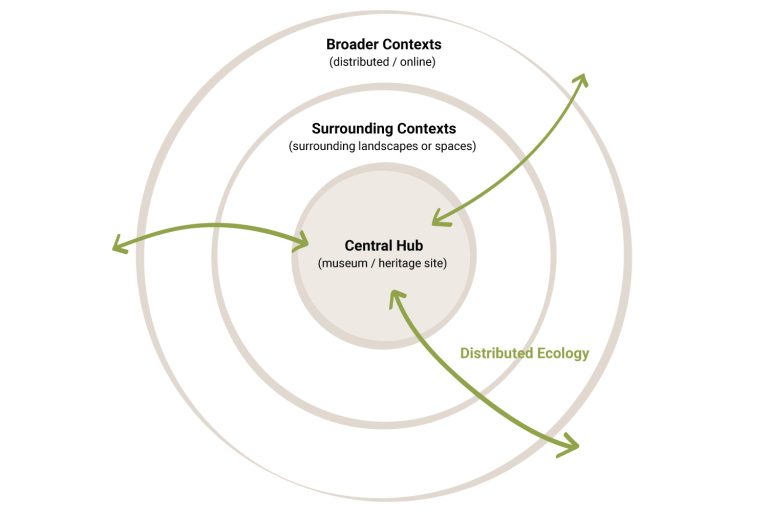
To design natureculture heritage experiences that extend beyond the museum as a bounded space, configuring it as a central hub within a distributed ecology of sites (indoors and outdoors), media (from screen-based to haptic and sound-based), and narratives (from interactive, story-driven games to interactive dialogues). The pattern is designed to layer visitors’ experiences across the different context characteristics and cognitive loads. The close museum space facilitates the intake of information and the heritage encounter through technology-mediated experiences, while outdoor nature experiences are designed to allow visitors to take full advantage of their natural heritage-laden surroundings with minimal, non-disruptive technologies. Finally, a more abstract layer of game-based reflection and speculations is available online.
2. Target
Problem
Natureculture heritage experiences are typically spread across closed and controlled interpretation centres and open-air landscapes. Spatially confined (e.g., within museum and visitors-centred walls), narratively linear, and human-centered, they are hence limited in their ability to represent ecological complexity and more-than-human perspectives. Therefore, they require different modes of experiencing.
Open-air naturecuture landscapes are rich and unpredictable. Furthermore, our research has shown that visitors to these natural spaces want to focus on the landscape rather than technological artifacts.
This can result in a fragmented understanding of heritage as separate “nature” and “culture” domains; low engagement with complex environmental issues; and limited emotional, embodied, and place-based connection.Dominant heritage narratives often privilege anthropocentric perspectives and material displays, neglecting entangled relationships across ecosystems.
Context
This pattern applies when:
- Natureculture heritage spans multiple sites (e.g., museums or interpretation centres, as well as open-air or natural environments).
- There is a need to communicate complex, interconnected systems (e.g., ecosystems, climate, biodiversity).
- Audiences are diverse (tourists, locals, students) with varying media literacies.
- Institutions aim to move toward posthuman / more-than-human heritage frameworks.
Typical contexts:
- Natural history museums linked to surrounding landscapes or outdoor spaces.
- Cultural institutions in ecologically sensitive or tourism-heavy regions.
- Archeological sites that span indoor and outdoor spaces.
Forces
The success of the pattern depends on balancing:
- Multiplicity vs Coherence: Multiple media and entry points must still form a meaningful whole.
- Exploration vs Guidance: Open-ended journeys vs narrative clarity.
- Technology vs Environment: Digital augmentation should not disrupt embodied or ecological experience.
- Scientific Rigor vs Narrative Engagement: Accurate knowledge vs accessible storytelling.
- Human vs More-than-human Representation: Decentering humans while maintaining relatability.
- Distributed Experience vs Institutional Control: Experiences unfold across spaces not fully controlled by institutions.
Consequences
Weaknesses:
- Risk of fragmentation or narrative incoherence.
- Higher design and coordination complexity.
- Requires careful orchestration across media and locations.
- Potential uneven user engagement (some parts skipped).Technical and logistical challenges in cross-site deployment.
Strengths:
- Enables layered, multi-perspective engagement with heritage.
- Supports plural, non-linear participation pathways.
- Bridges indoor–outdoor and digital–physical experiences.
- Fosters embodied, emotional, and reflective engagement.
- Better represents ecological interdependencies and entanglements.Increases accessibility by offering multiple entry points.
3. Application
Solution
Design a naturecuture transmedia heritage system where:
- The museum acts as a central hub, but not the sole experience.
- The experience unfolds across multiple interconnected contexts (e.g., nature sites, exhibition spaces, dedicated installations).
- Each medium contributes a distinct layer of meaning, rather than repeating content.
- Users can enter, navigate, and assemble their own journey.
- Narratives are structured around entanglements between human and more-than-human actors.
Transmedia experiences allow each medium to act as an entry point, contributing different facets of a broader narrative.
Rationale
This pattern responds to:
- The need to decenter the museum as the sole site and authorized heritage point of interest.
- The importance of situated, place-based engagement.
- The affordances of transmedia storytelling for complex narratives.
- Posthuman approaches that emphasize relationality and ecological interdependence.
By distributing the experience:
- Knowledge becomes situated and embodied.
- Narratives become plural and relational.
- Users become active assemblers of meaning, not passive recipients.
Implementation Details
Suggestions:
- Structure the experience into distinct but connected nodes (e.g., nature, exhibition, immersive room)
- Ensure each node has a specific experiential role, e.g.:
- Experiencing (embodied, sensory)
- Learning (informational, dialogic)
- Reflecting (interpretive, systemic)
- Design multiple entry points (users can start anywhere)
- Use different interaction intensities depending on context (low-tech in nature, richer tech in museum)
- Create narrative connectors (maps, tokens, characters, themes) linking experiences
- Embed more-than-human perspectives through characters, sensory cues, or interactions
- Allow non-linear navigation, but maintain thematic coherence.
Issues:
- Maintaining continuity across fragmented experiences.
- Aligning technical systems across locations.
- Ensuring accessibility across different user groups and abilities.
- Balancing freedom of exploration with narrative clarity.
Pitfalls:
- Overloading users with too many disconnected elements.
- Designing media redundantly instead of complementarily.
- Overusing technology in contexts where presence and reflection are key.
- Treating transmedia as distribution rather than meaningful differentiation.
- Failing to connect experiences through a shared conceptual framework.
Impact on…
User Experience: Becomes exploratory, personalized, and multi-layered.
Narrative Structure: Shifts from linear storytelling to distributed narrative assemblage.
Natureculture Heritage Interpretation: Expands toward plural, relational, and ecological perspectives.
Institutional Role: Moves from authority to facilitator of distributed meaning-making
Engagement with Natureculture: Strengthens situated, embodied, and ethical connections.
Example
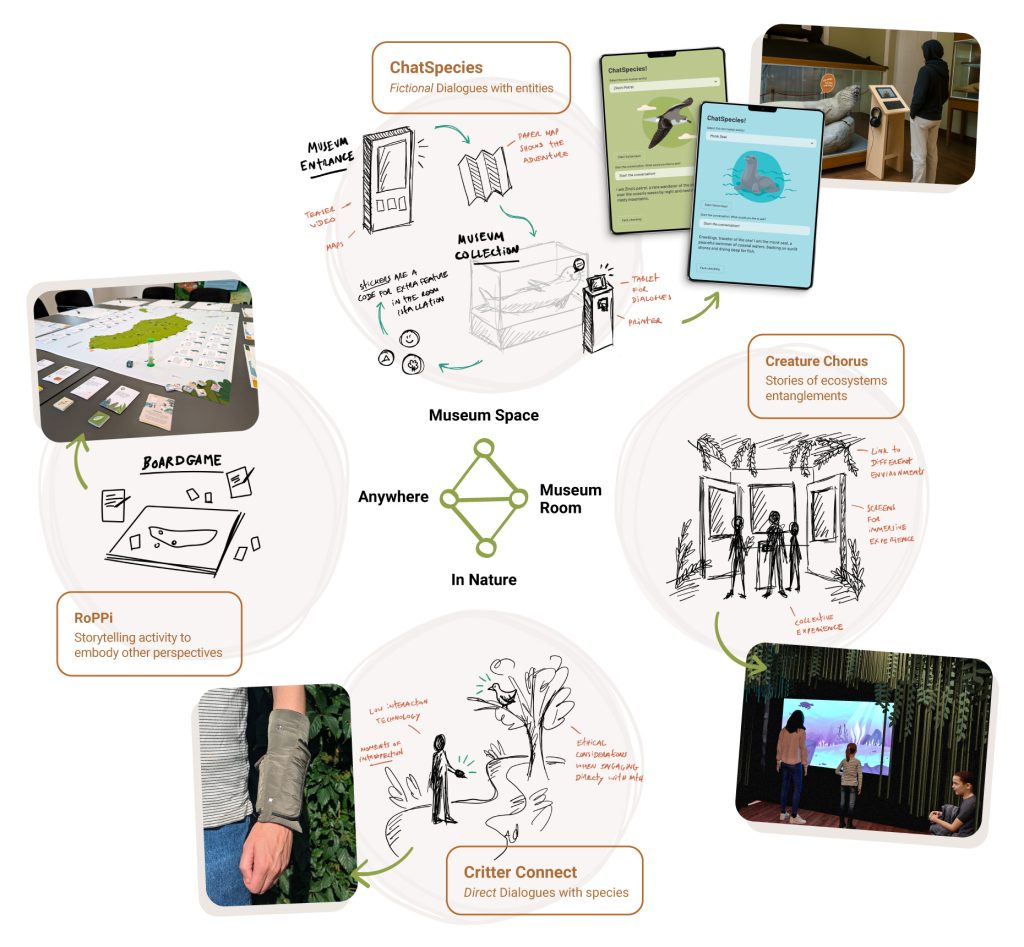
Madeira CS3 (Biotopia case study) applies this pattern through:
- A four-part transmedia journey across:
- Nature (Levadas/natural environments) – embodied, sensory engagement with more-than-human actors.
- Museum Exhibition – dialogic, knowledge-based interaction (e.g., MtH dialogues).
- Immersive Room – installation for systemic reflection on ecological entanglements.
- Physical (museum) and digital versions (online) – Board-inspired storytelling game for more-than-human perspectives and heritage connection.
- Each context contributes a distinct layer of experience:
- Direct interaction in nature
- Narrative and informational engagement in the museum
- Speculative and reflective systemic understanding in immersive space
- Users can navigate across these contexts non-linearly, assembling their own journey
This configuration reflects a transmedia structure where different media and locations collaboratively construct a holistic narrative.
4. Supplementary Information
Discussion
This design pattern reflects a shift from site-bound, linear natureculture heritage experiences toward distributed, transmedia ecologies of engagement. By positioning the museum as one node within a broader network of locations, media, and narratives, it enables participants to construct their own pathways through interconnected experiences. Rather than presenting a single authoritative storyline, the pattern supports plural, layered narratives where each medium contributes a distinct perspective. This approach is particularly suited to communicating complex phenomena such as natureculture entanglements, allowing for multiple entry points, forms of engagement, and interpretations.
At the same time, the pattern introduces important tensions that require careful design consideration. Balancing openness with narrative coherence is essential to avoid fragmented experiences, while integrating diverse media must remain legible and meaningful to varied audiences. Additionally, the role of technology must be context-sensitive, especially in natural environments where excessive mediation can disrupt embodied engagement. Ultimately, this pattern challenges traditional institutional roles, encouraging museums to act as facilitators of distributed meaning-making and supporting more situated, relational, and ecologically attuned forms of heritage engagement.
Team
- Prof Valentina Nisi – Principal Investigator
- Prof Nuno Nunes – Academic Investigator
- Dr Pedro Galvão Ferreira – Senior Post-doc
- Dr Marta Ferreira – Post-doc Researcher and Designer
- Dr Teresa Paulino – Post-doc Researcher
Collaborators:
- Mathilde Gouin – Researcher
- Vadym Volkovinskyy – Researcher and Developer
- Catarina Correia – Researcher
- Ying Xu – Researcher
Partners

Related Resources
-
Directional Audio Navigation Cues
1. Overview Pattern Level: Sub-pattern of Audio-First Dual-Mode NavigationPrimary Phase: GuidingOne-line Summary: A navigation mechanism that plays periodic spatially positioned musical cues derived from each character’s theme, giving players directional…
-
Character-Triggered Layer Transition
1. Overview Pattern Level: High-levelPrimary Phase: Cross-phaseOne-line Summary: A layer switching mechanism that transitions the player to a different content layer when they complete an encounter with a designated portal…
-
Orientation-Based Combat
1. Overview Pattern Level: High-level Primary Phase: PresentingOne-line Summary: A challenge mechanic that uses head orientation tracking to let players evade spatially positioned threats, turning the same sensing infrastructure used for…
-
Head-Directed Target Locking
1. Overview Pattern Level: Sub-pattern of Audio-First Dual-Mode NavigationPrimary Phase: GuidingOne-line Summary: A target selection mechanism that locks onto a navigation target when the player maintains head orientation toward it…
-
Progressive Proximity Audio Zones
1. Overview Pattern Level: Sub-pattern of Audio-First Dual-Mode NavigationPrimary Phase: PresentingOne-line Summary: A zone-based audio system that transitions players from silence through character music to narrative dialogue as they physically…
-
Audio-First Dual-Mode Navigation
1. Overview Pattern Level: High-levelPrimary Phase: Cross-phaseOne-line Summary: A navigation system that automatically separates exploration and content delivery into two distinct modes, preventing navigation audio and character audio from competing…


