
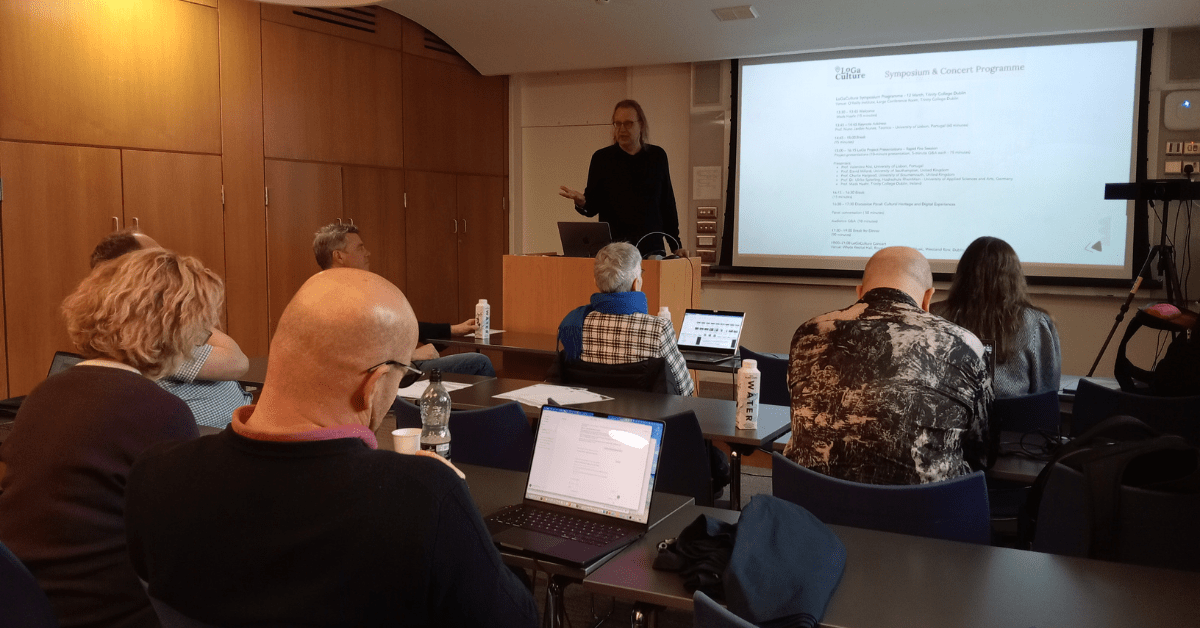
On 12 March 2026, the LoGaCulture project marked a major milestone with its Closing Symposium, hosted at the O’Reilly Institute at Trinity College Dublin. Titled “Bringing Locative Cultural Heritage Games to the Masses,” the event brought together around 30 academic participants from across Europe to reflect on the project’s achievements, challenges, and future directions.
The symposium opened with a welcome from Mads Haahr, Principal Investigator at Trinity College Dublin, setting the stage for a day of critical reflection and forward-looking discussion. A keynote address by Nuno Jardim Nunes from Instituto Superior Técnico followed, offering insights from the Horizon Europe Bauhaus of the Seas Sails project. His talk provided a complementary perspective on large-scale cultural and technological interventions, situating LoGaCulture within broader European research and innovation landscapes.
A Day of Reflection and Exchange
Throughout the day, LoGaCulture partners presented their work, showcasing a diverse range of case studies, design approaches, and evaluation strategies. These presentations highlighted the project’s interdisciplinary nature, spanning human-computer interaction, game design, and cultural heritage practice.
The programme also included dedicated sessions on final deliverables, the project’s legacy website, and its final report, alongside a rapid-fire presentation session featuring leading researchers including Valentina Nisi, David Millard, Charlie Hargood, Ulrike Spierling, and Mads Haahr.
A panel discussion on Cultural Heritage and Digital Experiences concluded the formal programme, bringing together perspectives from researchers in the UK, Lisbon, and Dublin, alongside a cultural heritage partner from Frankfurt. The panel critically examined the gap between ambition and implementation in digital heritage innovation.
Innovation Meets Reality
A key theme emerging from the symposium was the tension between innovation and implementation. While locative games and interactive technologies offer powerful new ways to engage with cultural heritage, participants highlighted the challenges of scaling these approaches beyond experimental contexts.
Discussions emphasised the need to align technological possibilities with institutional constraints, user expectations, and long-term sustainability. This included practical considerations such as maintenance, integration into heritage infrastructures, and the capacity of cultural organisations to adopt and support new technologies over time.
Expanding Dissemination Through Performance
The symposium extended beyond traditional academic formats with the LoGaCulture Concert, held at the Royal Irish Academy of Music and attended by approximately 90 participants. This public-facing event presented an innovative model for research dissemination, combining cultural performance with digital heritage outputs.
The concert demonstrated how complex technical and research-driven work can be communicated through artistic and experiential formats, engaging broader audiences in meaningful and memorable ways. Participants widely recognised this hybrid approach as a compelling alternative to conventional dissemination strategies.
From Discussion to Practice: Looking Ahead
The symposium concluded on 13 March with a field trip to three key heritage sites in Ireland: the Hill of Tara, the Battle of the Boyne Visitor Centre, and the National Botanic Gardens. These visits, developed in collaboration with the Office of Public Works, allowed participants to experience locative game interventions in situ.
By engaging directly with the sites and technologies, participants were able to ground the symposium’s discussions in real-world application, offering feedback and reflecting on the practicalities of implementation in live heritage environments.
The LoGaCulture Closing Symposium underscored both the promise and the complexity of bringing locative cultural heritage games to wider audiences. By combining critical discussion, experiential learning, and innovative dissemination formats, the event provided a comprehensive reflection on the project’s legacy.
As the project concludes, its findings point towards a future in which digital and locative technologies are not only creatively ambitious but also operationally viable — capable of transforming how cultural heritage is experienced, understood, and shared.