
1. Overview
Name
- Board-Structured Speculative Storytelling
Intent
To support engaging, inclusive, and reflective heritage experiences by combining the social and procedural qualities of board games — such as turns, movement, prompts, roles, and shared progression — with storytelling conventions, such as the hero’s journey and speculative design, encouraging players to imagine heritage through multiple perspectives, including human, non-human, historical, and fictional viewpoints. The pattern is intended to transform heritage interpretation from passive reception into participatory story-making.
2. Target
Problem
Cultural heritage experiences often remain static, didactic, and individually consumed. Even when digital storytelling and gaming are used to communicate and interact with heritage, they frequently rely on factual transmission, linear narratives, or tightly predefined interactions, leaving limited room for reflection, participation, speculative imagination, or posthuman perspectives. This design pattern proposes to combine interactivity, inclusivity, and speculative storytelling to bridge nature and culture in meaningful ways.
Context
This pattern is appropriate when:
- The goal is to engage audiences with local heritage through active participation rather than passive interpretation.
- The heritage context benefits from multiple viewpoints, especially where human and non-human relations are central.
- Designers want to support both playful social interaction and structured narrative production.
- The experience may exist in physical, digital, or hybrid form.
- Storytelling is intended not only to communicate heritage, but to help participants reinterpret, appropriate, and reflect on it.
Typical settings include locative games, museum-based heritage games, classroom heritage activities, community storytelling workshops, and mixed physical-digital cultural experiences.
Forces
The success of the pattern depends on balancing the following forces:
- Play vs. writing: if mechanics are too dominant, the narrative becomes thin; if writing dominates, the experience may cease to feel like a game.
- Structure vs. creativity: players need enough scaffolding to build coherent stories, but not so much that their contribution becomes formulaic.
- Social interaction vs. individual reflection: the design should preserve the shared energy of group play while still allowing personal expression.
- Speculation vs. heritage grounding: imaginative storytelling works best when it remains connected to place, ecology, and heritage context.
- Role embodiment vs. accessibility: characters and prompts should be evocative enough to inspire perspective-taking, but simple enough for diverse audiences to use.
- Narrative coherence vs. replayability: branching prompts and freedom increase variety, but too much openness can fragment the story.
Consequences
Weaknesses:
- Story coherence can break down if prompts feel repetitive or disconnected.
- Social play may weaken when the design overemphasizes individual writing tasks.
- Digital adaptation can reduce the shared immediacy of co-located board play.
- Character roles may feel too shallow if they lack dramatic tension or emotional depth.
Strengths:
- Encourages inclusive participation through multiple roles, perspectives, and expressive modes.
- Supports reflection, recollection, and imaginative engagement with heritage.
- Makes heritage more accessible by turning it into a shared, playful, authoring process.
- Bridges physical and digital heritage interaction through transferable mechanics.
- Helps players explore heritage across temporal, speculative, and more-than-human dimensions.
3. Application
Solution
Design the heritage experience as a prompt-driven storytelling game structured by board game mechanics and narrative conventions.
The pattern combines five core elements:
- A shared progression system: Players move through a path, network, or map that gives rhythm, sequence, and group visibility to the experience.
- Embodied player roles: Players adopt characters with distinct viewpoints, motivations, or constraints, including human, nonhuman, historical, or speculative personas.
- Prompt-based narrative generation: Story fragments are created in response to location-based, thematic, or challenge-based prompts.
- A narrative arc: Storytelling is organized by a recognizable narrative convention, such as the Hero’s Journey, to help players build a coherent story from beginning to end.
- Reflection and synthesis: The experience ends with a concluding step that asks players to interpret, share, or distill meaning from their journey.
Rationale
WP4’s research has shown that game mechanics and open-ended writing alone were not sufficient. Stronger board-game structures created energy and engagement but suffered from downtime and uneven narrative depth. Focusing on writing improved reflection but weakened social dynamics. Movement across the game board, shared visibility, timed play, stronger prompts, and a clearer narrative framework through the Hero’s Journey helped players engage with heritage through coherent, meaningful stories.
Board game conventions provide external structure and group dynamics, while speculative design and narrative conventions provide interpretive freedom and perspective-taking. Together, they support heritage engagement as both play and authorship.
Implementation Details
Suggestions:
- Use a map or networked board tied to real places so movement feels meaningful and grounded in heritage geography.
- Give players character roles that frame perspective and motivate storytelling.
- Use prompt cards organized by theme, such as nature, history, actions, senses, or landmarks.
- Pair each prompt with a specific narrative stage so each fragment contributes to a larger story arc.
- Keep writing tasks short and bounded to reduce friction and maintain play rhythm.
- Use timing devices, turn cycles, or synchronous rounds to keep momentum.
- Include custom character creation to increase agency and identification.
- End with a reflection, recap, or a story-sharing phase so players can collectively interpret the experience.
Issues:
- Long waits between turns can reduce immersion and create frustration.
- Prompts may help with writer’s block, but weak prompts can produce repetitive or fragmented stories.
- Players may struggle to connect isolated story fragments into a coherent whole unless the narrative arc is clearly scaffolded.
- In digital multiplayer versions, players may progress simultaneously without feeling socially connected.
- Visual scale, layout clarity, and board readability matter: maps, paths, tokens, and writing sheets must remain legible and playable.
Pitfalls:
- Making the board purely decorative, with no real effect on story progression.
- Letting storytelling become so unstructured that players cannot assemble a satisfying narrative.
- Overdesigning characters so players feel constrained, or underdesigning them so embodiment feels superficial.
- Treating speculative play as detached fantasy rather than anchoring it in real heritage, memory, and place.
Impact on…
Participants
The pattern supports deeper engagement by inviting players to imagine, reflect, and author a first-person interaction with local heritage rather than simply consuming it. It can lower barriers to participation by accommodating different learning styles and expressive preferences.
Narrative experience
It improves coherence by giving players a stable structure for authoring stories through a recognizable dramatic arc (the hero’s journey), while still allowing diverse and speculative interpretations.
Social interaction
When well balanced, it creates shared awareness, anticipation, and mutual curiosity about each other’s journeys and stories, and, therefore, about the heritage that inspires them.
Heritage interpretation
It shifts heritage from a fixed body of knowledge to a participatory field of meaning-making shaped by memory, place, role-play, and speculation.
Digital transformation
It offers a transferable path from physical game formats to digital heritage experiences, while highlighting that digital versions must deliberately reconstruct social presence and story sharing.
Example
Madeira CS3 evolved this design pattern as the backbone of the natureculture heritage game RoPPi. As the pattern stabilized, the pattern materialized into a digital platform that allows heritage and cultural operators and lay audiences to design their own local natureculture heritage game. In this case, board game-inspired mechanics include movement across a map of Madeira, dice-based progression, prompt cards, turn structure, player roles, and shared pacing. These mechanics are combined with speculative narrative conventions such as first-person role-play, multi-perspective storytelling, more-than-human embodiment, and a Hero’s Journey-based writing structure. Through these combined elements, players create short story fragments tied to locations, challenges, and heritage encounters, eventually assembling a complete story about Madeira’s natureculture landscapes. In later iterations, this pattern was carried into a digital prototype that preserved map-based movement, structured prompts, and narrative stages while expanding access through solo and multiplayer modes.
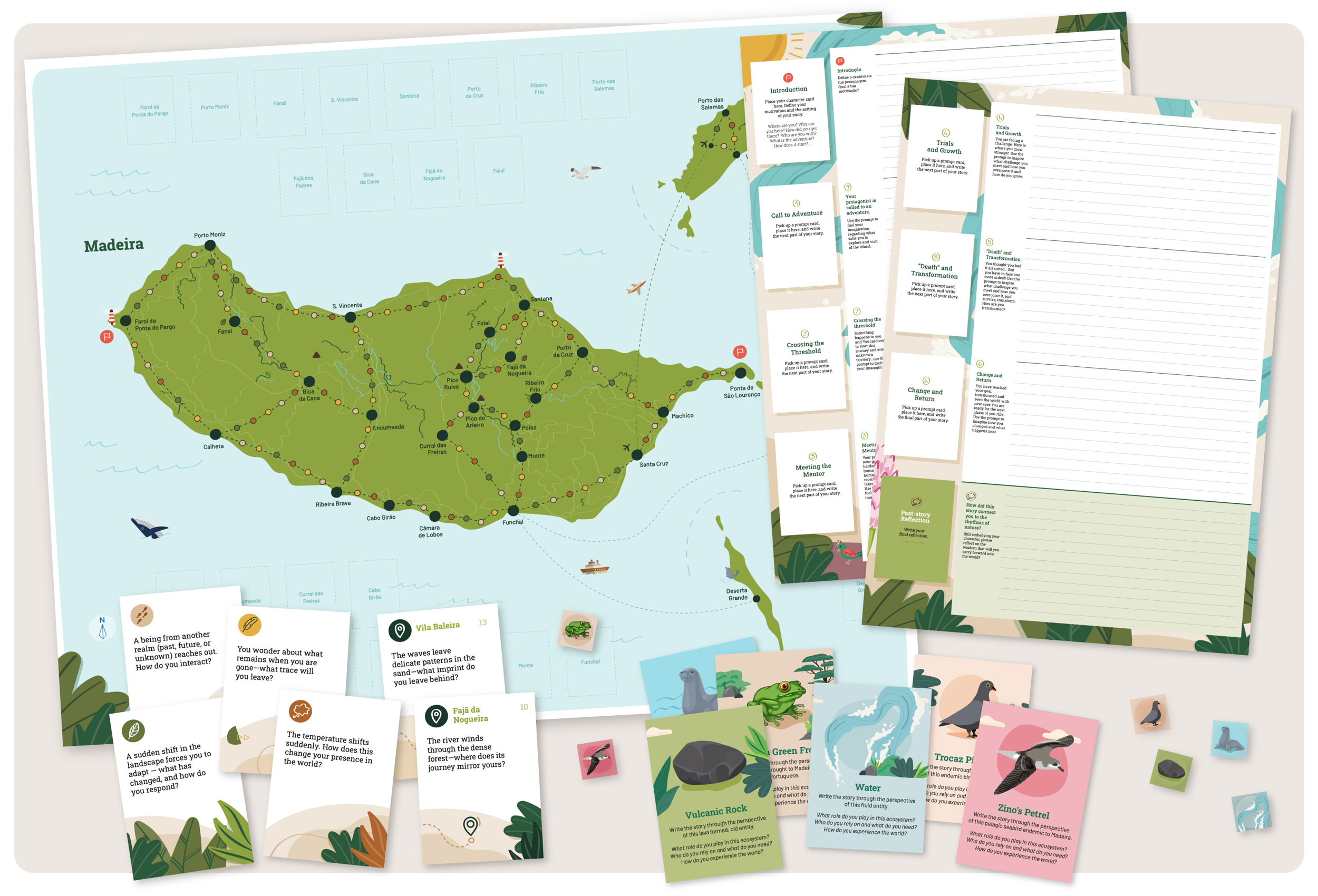 RoPPi – Game elements
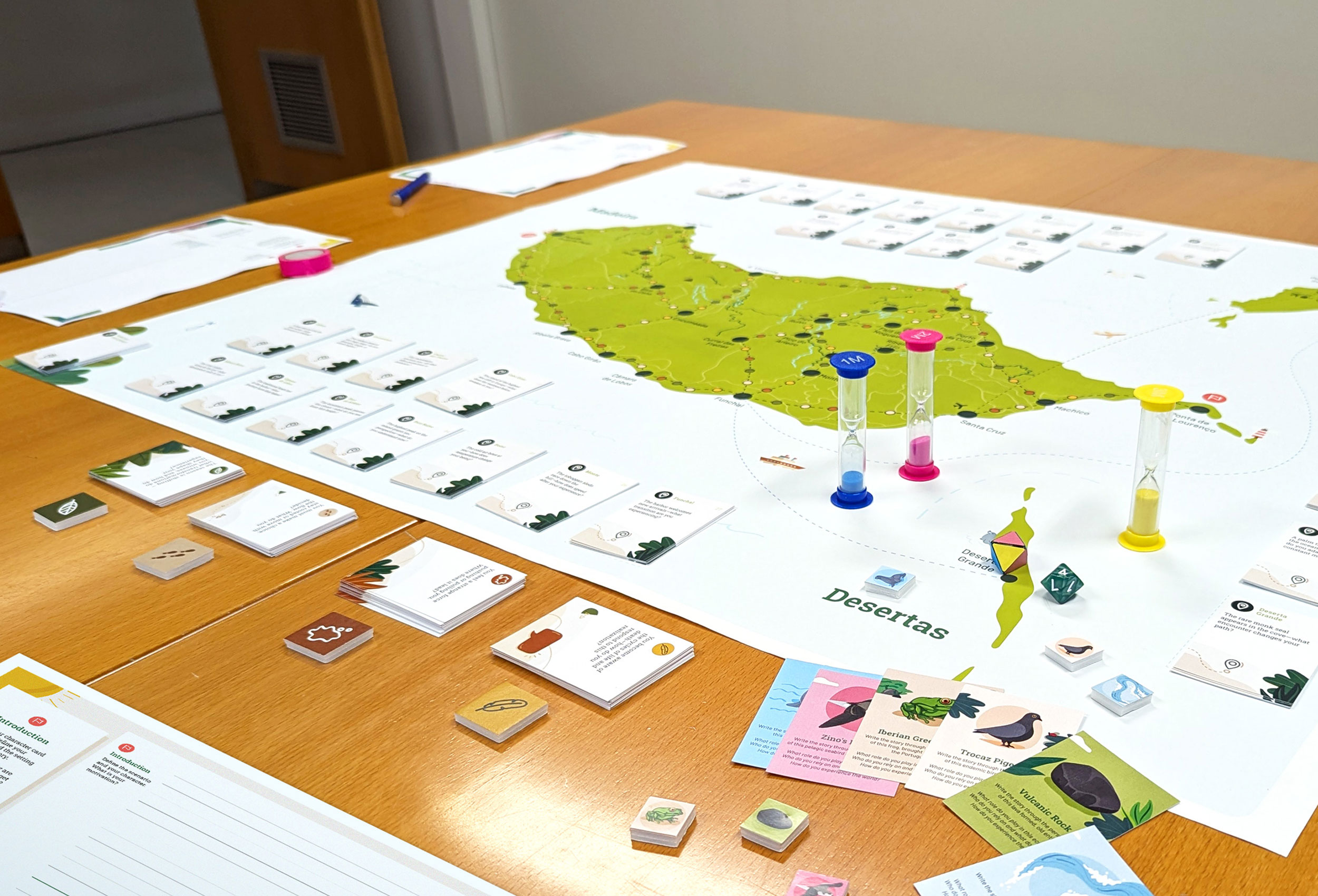 RoPPi – Physical version
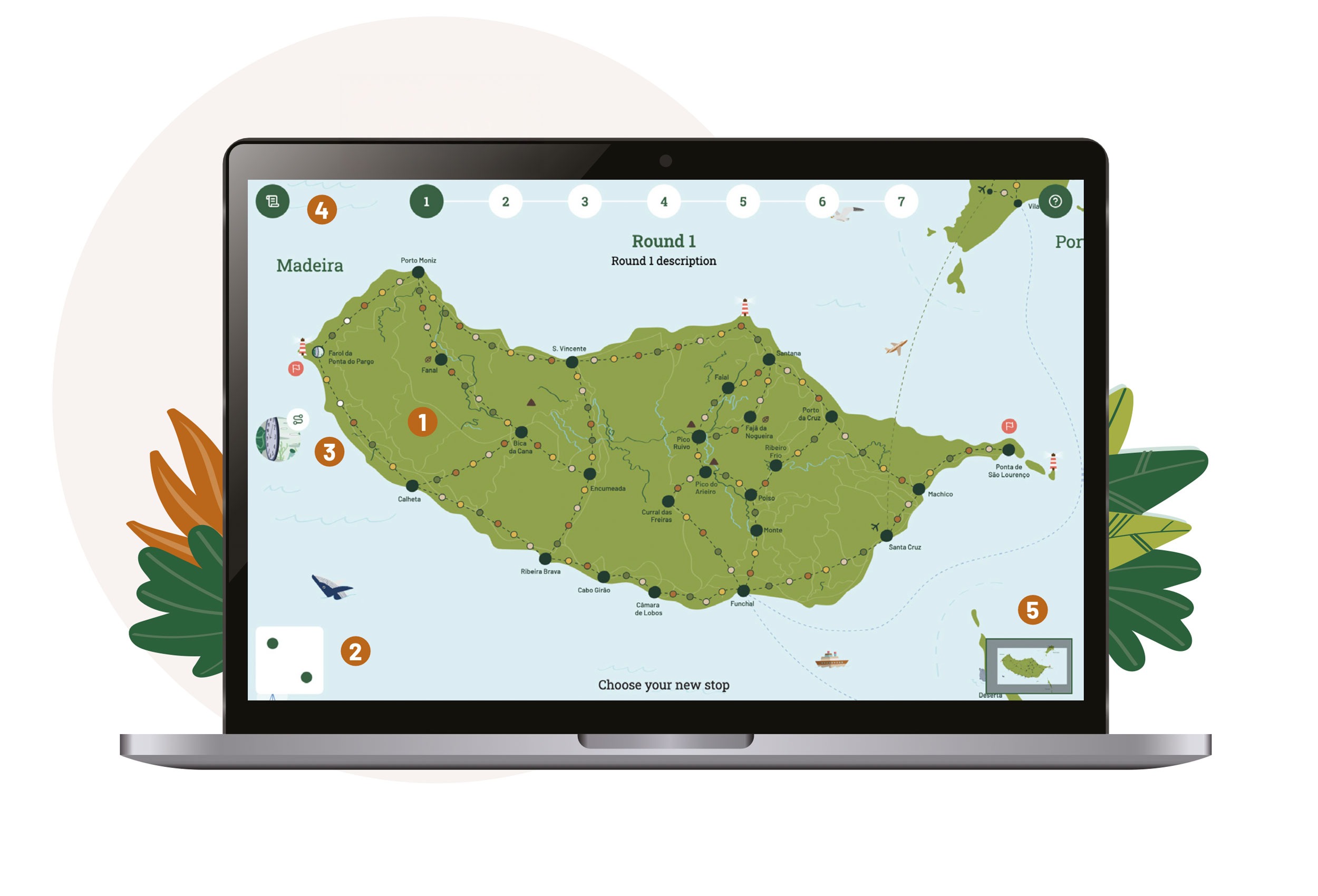 RoPPi – Online version
4. Supplementary Information
Discussion
This design pattern is relevant for heritage projects that want to foreground the richness of their local natureculture heritage. The game combines the accessibility and sociability of game structures with the interpretive richness of speculative design and the engagement of structured first-person storytelling. Board game mechanics and narrative conventions together can function as a design framework for participatory heritage sense-making. In CS3’s work, this combination evolved iteratively through playtesting, demonstrating that the balance between mechanics and narrative is crucial. The pattern evolved from the specific game to a general digital platform that allows a wide variety of audiences to create their own game based on their own location of choices.
Analytically, the pattern contributes a practical model for designing heritage experiences that are reflective, multi-perspectival, and inclusive. It is particularly strong in contexts where heritage is contested, layered, ecological, or relational, since speculative storytelling allows players to move across temporalities and viewpoints. At the same time, the pattern requires careful implementation: prompts must be well-crafted, narrative structure must guide without overdetermining, and digital translations must compensate for the reduced social immediacy of tabletop play. As a reusable LoGaCulture pattern, it is therefore best understood not as a fixed format, but as a structured design strategy for combining shared procedural play with guided speculative narration.
Team
- Prof Valentina Nisi – Principal Investigator
- Prof Nuno Nunes – Academic Investigator
- Dr Pedro Galvão Ferreira – Senior Post-doc
- Dr Marta Ferreira – Post-doc Researcher and Designer
- Dr Teresa Paulino – Post-doc Researcher
- Mathilde Gouin – Researcher
- Vadym Volkovinskyy – Researcher and Developer
Partners

Related Resources
-
Directional Audio Navigation Cues
1. Overview Pattern Level: Sub-pattern of Audio-First Dual-Mode NavigationPrimary Phase: GuidingOne-line Summary: A navigation mechanism that plays periodic spatially positioned musical cues derived from each character’s theme, giving players directional…
-
Character-Triggered Layer Transition
1. Overview Pattern Level: High-levelPrimary Phase: Cross-phaseOne-line Summary: A layer switching mechanism that transitions the player to a different content layer when they complete an encounter with a designated portal…
-
Orientation-Based Combat
1. Overview Pattern Level: High-level Primary Phase: PresentingOne-line Summary: A challenge mechanic that uses head orientation tracking to let players evade spatially positioned threats, turning the same sensing infrastructure used for…
-
Head-Directed Target Locking
1. Overview Pattern Level: Sub-pattern of Audio-First Dual-Mode NavigationPrimary Phase: GuidingOne-line Summary: A target selection mechanism that locks onto a navigation target when the player maintains head orientation toward it…
-
Progressive Proximity Audio Zones
1. Overview Pattern Level: Sub-pattern of Audio-First Dual-Mode NavigationPrimary Phase: PresentingOne-line Summary: A zone-based audio system that transitions players from silence through character music to narrative dialogue as they physically…
-
Audio-First Dual-Mode Navigation
1. Overview Pattern Level: High-levelPrimary Phase: Cross-phaseOne-line Summary: A navigation system that automatically separates exploration and content delivery into two distinct modes, preventing navigation audio and character audio from competing…


