
1. Overview
A floor-based entry zone for activating AR exhibits.
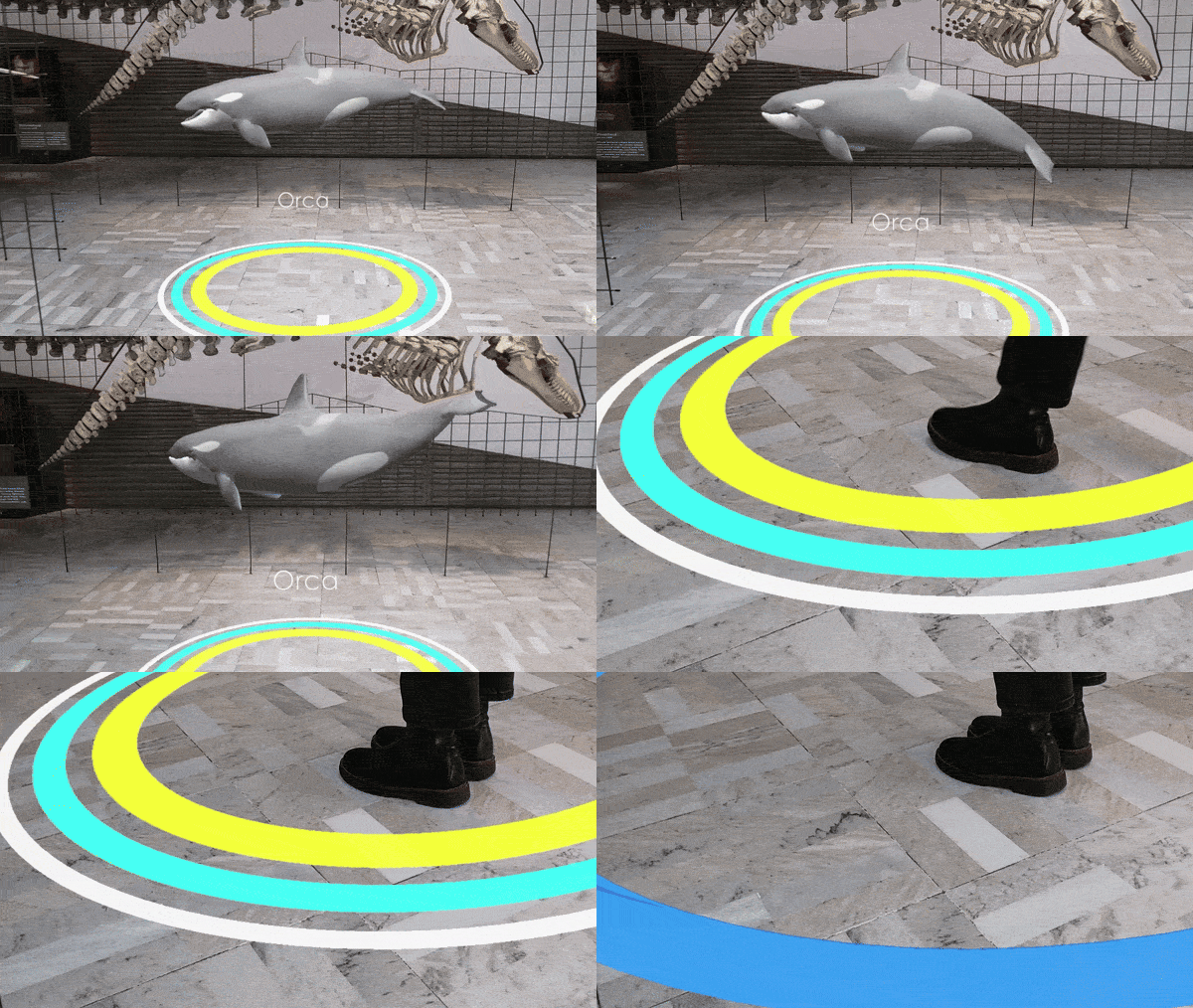
Name
- Step-In Circle
Intent
Provide a clear, proximity-based AR entry point that encourages natural, embodied activation of exhibit experiences without requiring complex input.
2. Target
Problem
Visitors often struggle to distinguish AR-capable exhibits and may miss opportunities to engage at their own pace.
Context
- Only select exhibits offer AR content, so cues must stand out.
- Visitors roam freely without a fixed route.
- Activation must feel seamless, avoiding handheld controls or intricate gestures.
Use When
- Visitors are scanning for interactive exhibits.
- Approaching an AR-capable exhibit warrants a clear “entry zone.”
- Designers want a spatial, proximity-driven activation method.
Forces
- Visibility vs. Subtlety: The circle must attract attention without obstructing sightlines.
- Proximity Accuracy: Reliable detection of user position to avoid false positives/negatives.
- Multimodal Feedback: Combining visual, audio, and animation cues to confirm activation.
Consequences
Weaknesses:
- Overly dense trigger areas may cause the trigger to activate unexpectedly or fail to function properly; overly bright or large trigger areas may cause clutter on the ground.
Strengths:
- Intuitive activation, reduced learning curve, preserves immersion.
3. Application
Solution
1. Spatial Entry Trigger
- Render a virtual circle on the floor in front of the exhibit.
- Activation fires after ~0.40 s of stable dwell once the user’s feet are inside the circle to suppress false positives.
- Place the circle center ~1.0 m from the exhibit’s leading edge (adjustable 0.8–1.2 m) to balance visibility and safety.
2. AR Experience Indicator Interface
- Above or beside the circle, display:
- A looping 3D model (e.g., a swimming orca).
- A title label in legible typography (e.g., “Orca”).
- Subtle pulsing or glow on the circle’s edge.
3. Activation Mechanism
- On entry:
- Play a spatial audio cue (chime or splash).
- Fade out the model, label, and circle.
- Voice prompt confirms launch: e.g., “Orca AR experience launched”. (Optional)
4. Feedback Cues
- Visual disappearance of interface elements.
- Spatialized audio confirmation.
Rationale
- Anchoring a simple visual zone to the floor leverages natural proximity behavior, reducing cognitive load and eliminating the need for manual controls. A brief dwell and a safe standoff from the exhibit provide reliability and comfort, while multimodal cues keep feedback clear without distraction.
Design Parameters
- Circle Radius: 0.6–1.2 m (default 0.9 m)
- Dwell Time: ~0.40 s stable inside the zone before trigger
- Placement (from exhibit leading edge): 0.8–1.2 m to balance visibility and safety
- Label Height: ~0.5 m above floor (peripheral visibility)
- Fade Duration (optional): ~0.5 s for interface elements to dissolve
Example
In an HMD-based AR museum installation, visitors approach an exhibit that supports digital augmentation. A glowing circle on the floor, accompanied by a floating title and 3D preview model, signals that an AR experience is available. Once the visitor steps into the circle and remains there briefly, the interface dissolves, a short spatial audio cue confirms activation, and the system launches the next interaction stage, such as a structured explanation or an exhibit-specific AR activity.
Notes
The Step-In Circle pattern makes AR content more accessible and discoverable through spatially grounded, low-friction interaction. By relying on embodied triggers and minimal UI, it supports intuitive engagement while preserving immersion in the exhibition space. This design is especially effective for visitors unfamiliar with gesture-based systems or those exploring independently without guidance.
Related Patterns:
- Avatar Guide: Step-In Circle often follows Avatar Guide. After the avatar leads visitors to a point of interest, the circle provides a clear, embodied way to activate the next AR experience.
- Sequential Explanation: After activation, Step-In Circle can hand over to Sequential Explanation when exhibit information is presented in a structured, step-by-step format.
- Labelling: Step-In Circle can also precede Labelling when visitors are about to inspect individual components of an exhibit in more detail.
- AR Exhibit Reassembler and AR Exhibit Feature Drawing: In playful or exploratory scenarios, the circle can serve as the activation point for more hands-on AR interactions such as reassembly or creative drawing tasks.
Team
- Yu Liu – Researcher and AR Designer/Developer
- Dr. Ulrike Spierling – Principal Investigator
Partners

Related Resources
-
Directional Audio Navigation Cues
1. Overview Pattern Level: Sub-pattern of Audio-First Dual-Mode NavigationPrimary Phase: GuidingOne-line Summary: A navigation mechanism that plays periodic spatially positioned musical cues derived from each character’s theme, giving players directional…
-
Character-Triggered Layer Transition
1. Overview Pattern Level: High-levelPrimary Phase: Cross-phaseOne-line Summary: A layer switching mechanism that transitions the player to a different content layer when they complete an encounter with a designated portal…
-
Orientation-Based Combat
1. Overview Pattern Level: High-level Primary Phase: PresentingOne-line Summary: A challenge mechanic that uses head orientation tracking to let players evade spatially positioned threats, turning the same sensing infrastructure used for…
-
Head-Directed Target Locking
1. Overview Pattern Level: Sub-pattern of Audio-First Dual-Mode NavigationPrimary Phase: GuidingOne-line Summary: A target selection mechanism that locks onto a navigation target when the player maintains head orientation toward it…
-
Progressive Proximity Audio Zones
1. Overview Pattern Level: Sub-pattern of Audio-First Dual-Mode NavigationPrimary Phase: PresentingOne-line Summary: A zone-based audio system that transitions players from silence through character music to narrative dialogue as they physically…
-
Audio-First Dual-Mode Navigation
1. Overview Pattern Level: High-levelPrimary Phase: Cross-phaseOne-line Summary: A navigation system that automatically separates exploration and content delivery into two distinct modes, preventing navigation audio and character audio from competing…


