
1. Overview
Name
- Designing for Serendipity
Intent
Creating magic moments of serendipity to blend reality where the game and real location seem to align.
2. Target
Problem
Creating effective mixed reality experiences demands blending the reality of the game with the physical reality of the site to create a sense of two worlds that are connected and part of each other. However, locative experiences can sometimes feel separated from the space within which they are set in a way that fails to capitalize on the immersive potential of mixed reality.
Context
The user is playing a locative game at a heritage site where there is potential to further blend the reality between the game and the location.
Forces
The success of this pattern in non-deterministic as it depends on events outside the game occurring. As such the predictability and likelihood of these events will impact the frequency with which the desired result is achieved.
Consequences
Weaknesses:
- This design pattern is unpredictable and will not work for every player. Rather the designer works to maximize the chance of it occurring without it being certain.
Strengths:
- By designing with a view towards serendipitous moments of collision between realities we can create “magic moments” where the two align that create both locative game harmony and a memorable experience.
3. Application
Solution
By encouraging the player to observe their surroundings and making reference to likely occurrences (such as groups of people often at the site, likely weather, or common environmental factors. This can create moments of surprise and delight in which game worlds and real worlds align, promoting a sense of ludic harmony and joy in an unexpected reframing of the material world.
We identify two forms of this pattern – intentional and unintentional. For intentional serendipity the designer notes that while serendipity can’t be explicitly planned (or it would cease to be serendipity), it can be fostered with intent in the following ways:
- Opportunity through Abundance: by providing many opportunities for the game world and real world to align, however briefly, the designer improves chances that they will do so.
- Opportunity through Popularity: by refining opportunities based on popular use-patterns of sites, the designer improves the likelihood that events within the game world and the real world may align.
Unintentional serendipity relies on universal chaos, and habits of apophenia among users. As such, it is not very reliable. However, we would propose that the magic circle of game-player thinking represents an opportunity to foster pattern-thinking which, in the context of locative games, encourages players to see the material world differently than when not framed by the context of games. Unintentional serendipity is fostered by (ludo)narratively embedding the game fiction within a realistic context for the site. It is then up to the player to make links that make sense to them. It’s like emergent narrative, but more like emergent ludic harmony.
Rationale
The immersive potential of mixed reality experiences relies on a sense of magically blending the two realities. While this can be done using technology and narrative, designing serendipitous collisions can amplify this experience.
Implementation Details
Suggestions:
- Intentional serendipity through abundance
- Intentional serendipity through popularity
- Unintentional serendipity
Issues:
- This design strategy is inherently unpredictable
Pitfalls:
- Designing an experience that relies on serendipity will frequently fail. The pattern is for enhancing experiences rather than a central pattern of play.
Impact on Player Experience
Serendipity in mixed reality experiences shares some design principles with that of emergent narrative – in that it is, to some extent about the designer hedging their luck, creating a context where the player is encouraged to look for connections, and leveraging the apophenia to find connections out of chaos. The designer can plan for this through intentional serendipity or create ambiguous experiences in a context where players will be looking for reality blending and where unintentional serendipity may happen.
The impact of this is arguably one of further and enhanced immersion as the player increasingly sees connections between their game and the reality they are inhabiting. While they cannot be relied upon to certainly occur creating an experience rich in serendipitous potential within the magic circle of a mixed reality game can see the immersion amplified.
Example
As part of CS2 and the Avebury Adventures Anthology designers experimented with designing for serendipity in a range of experiences.
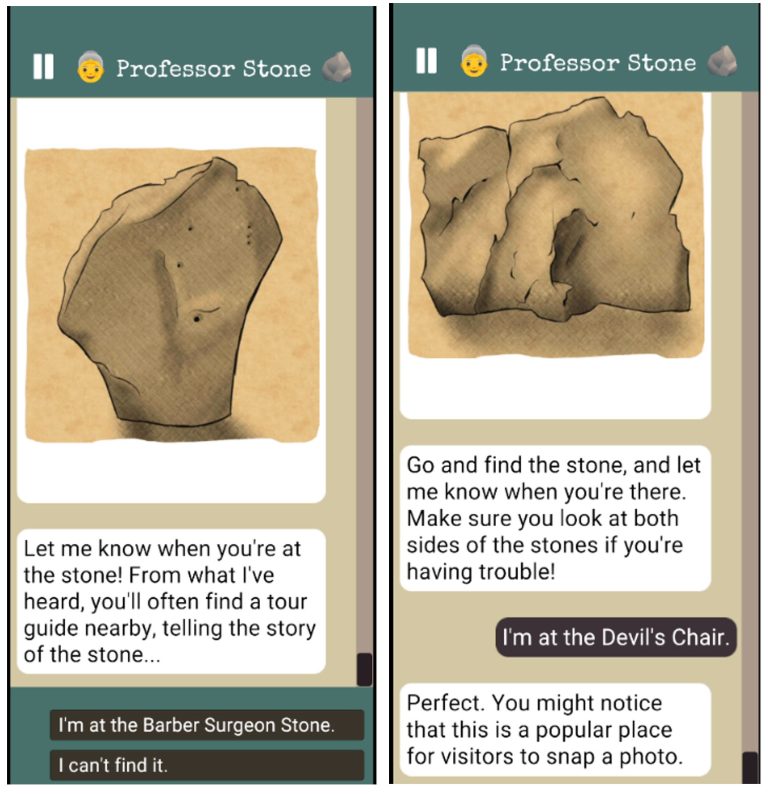
The experience was very positive reviewed by players who both enjoyed the creativity of the game but also the novelty of this way of engaging with the heritage site. The gathering of inspiration/sticks took players on a walk around the site where they could experience a range or locations but then the act of creation also encouraged them to spend time observing the site in order to inform that creation.
Two tours of Avebury take place each day, excepting extreme weather. Of Avebury’s many stones, ‘The Devil’s Chair’ is among the most popular with visitors. The designer makes diegetic reference to the player encountering tour groups and visitors with cameras. On a harsh winter day it is unlikely that the player would encounter either phenomenon (however, it is also less likely that they would choose to play an outdoor game on such a day). On even a mild spring day before the heavy tourist season, both phenomena occurred.
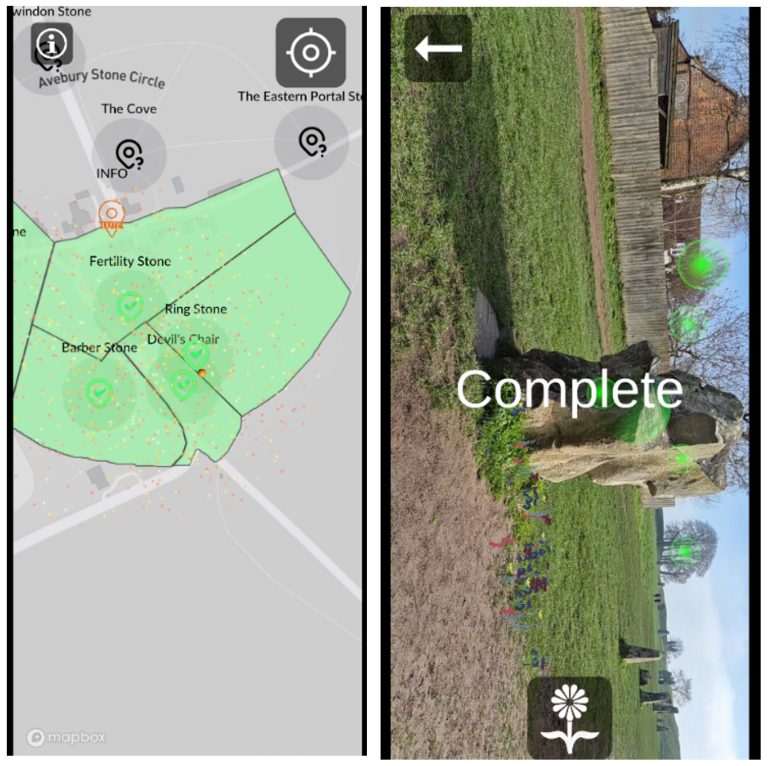
Unintentional serendipity is harder to example as, but its nature, it is less explicit design and more design occurring within a space where it can emerge and where the player is perhaps likely to look for it
An example could be seen in Bloom and Wander – a puzzle game where the player travels to stones at Avebury, solves mixed reality spatial puzzles at stones, and as they succeed flowers bloom around the site coloring in an initially grey map and in mixed reality around the stones themselves. A player experience on a misty day noted that as the mist lifted from the stones bringing colour to reality the grey map of the game also became colorful creating an unintended, but effective, serendipitous moment.
4. Supplementary Information
Biography
Version 1.0 (19/3/26) – Initial pattern based on close reading analysis. Charlie Hargood (BU)
Discussion
This could be considered a design strategy rather than a singular explicit pattern, a means for the designer to shape other patterns towards the potential reward of serendipity.
Team
- Charlie Hargood – Principal Investigator
- Jack Brett – Researcher
- Bob Rimington – Researcher
Partners

Related Resources
-
Directional Audio Navigation Cues
1. Overview Pattern Level: Sub-pattern of Audio-First Dual-Mode NavigationPrimary Phase: GuidingOne-line Summary: A navigation mechanism that plays periodic spatially positioned musical cues derived from each character’s theme, giving players directional…
-
Character-Triggered Layer Transition
1. Overview Pattern Level: High-levelPrimary Phase: Cross-phaseOne-line Summary: A layer switching mechanism that transitions the player to a different content layer when they complete an encounter with a designated portal…
-
Orientation-Based Combat
1. Overview Pattern Level: High-level Primary Phase: PresentingOne-line Summary: A challenge mechanic that uses head orientation tracking to let players evade spatially positioned threats, turning the same sensing infrastructure used for…
-
Head-Directed Target Locking
1. Overview Pattern Level: Sub-pattern of Audio-First Dual-Mode NavigationPrimary Phase: GuidingOne-line Summary: A target selection mechanism that locks onto a navigation target when the player maintains head orientation toward it…
-
Progressive Proximity Audio Zones
1. Overview Pattern Level: Sub-pattern of Audio-First Dual-Mode NavigationPrimary Phase: PresentingOne-line Summary: A zone-based audio system that transitions players from silence through character music to narrative dialogue as they physically…
-
Audio-First Dual-Mode Navigation
1. Overview Pattern Level: High-levelPrimary Phase: Cross-phaseOne-line Summary: A navigation system that automatically separates exploration and content delivery into two distinct modes, preventing navigation audio and character audio from competing…


