
1. Overview
Name
- Popular Name: Adaptive Locations
- Alternative Names: Alternative routing
Intent
To distribute footfall of people in such a way as to prevent oversaturation of single areas and protect individual spaces.
Operation: Navigation Pattern
Underlying Principle: Diffusion of people
Strength of Evidence: Tested on site (Ages of Avebury)
2. Target
Problem
A system with a predefined path and locations would cause many people to follow the same path, potentially causing erosion, disrupting the site/visitors that are not participating, and overcrowding around key locations.
Context
- Situation: The user is holding a device, and has to go to a new location – the location needs to be chosen as to help with the distribution of footfall and dispersion, and the user needs a way to be able to tell the system if the chosen location is unreachable.
- Environment: A space with multiple possible paths.
Forces
The success of the pattern depends on:
- The number of locations available for each node (more is better)
- The openness of the space
- The availability of each location
- The affordances and the complexity of the navigational system
- The complexity of the local topology
Consequences
Weaknesses:
- W1: The application could pick a location that is unreachable
- W2: When designing, sometimes there are no alternate locations, so you either have to funnel everyone through a single location, or pick a close one (might not fit as much)
- W3: All locations for a node could be unreachable
- W4: If in a group with multiple people playing the game on different devices, the challenge to keep people in sync will inadvertently lead to location mismatch at points
Strengths:
- S1: Compared to a single path experience, the players are given different locations for each node, adding variety
- S2: Can be more robust with redundancy added
- S3: Convenience of choice location
- S4: Diffuses visitors, helps with erosion, and does crowd management
3. Application
Solution: An system that lets you anchor one node to multiple locations, and a mechanism that selects that location at runtime
Sensitizer: A map of the Avebury Henge Site, with example arrows for paths that people can take, and node locations for each story beat (each node has two possible locations)
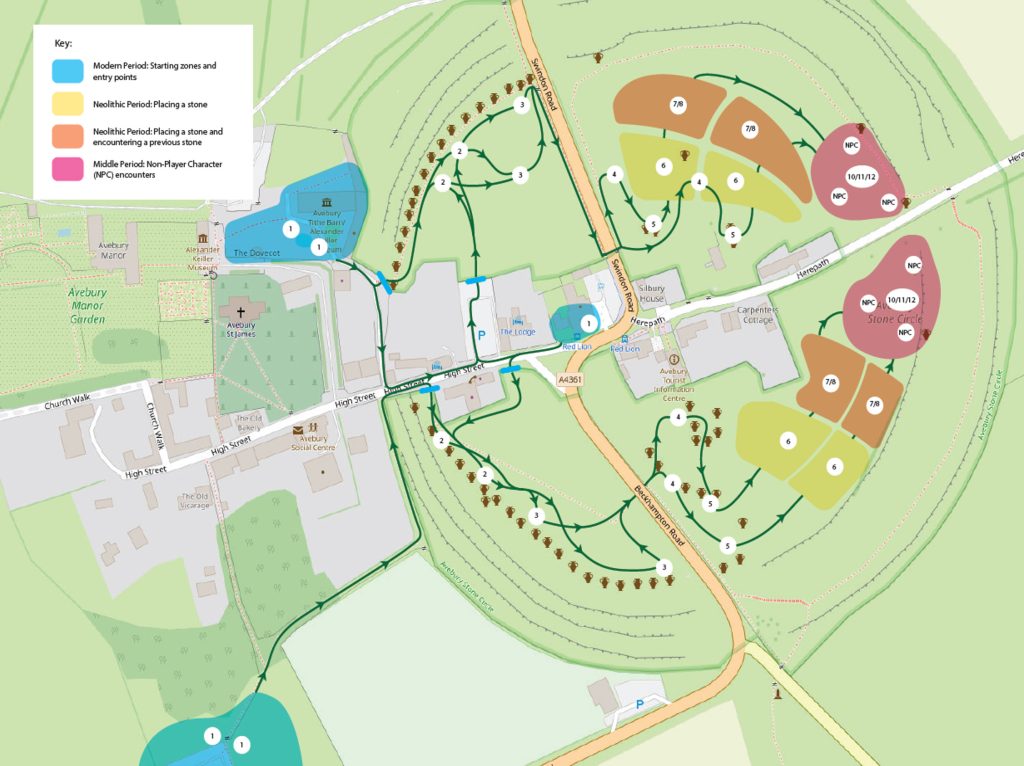
Participants: Designed for a single participant or a shared experience.
Breakdown:
- A model of alternative locations.
- An algorithm for selecting locations at runtime.
Variations:
- Skip location design pattern: Can have a way to skip the current location and continue the story in case of unreachability or other problems with the location
- User choice of location: Can give the user a choice between multiple locations on a map
- Algorithmic choice of location: Can use different algorithms to pick up the next location (random, time based, weather based, etc.)
Rationale
Makes users disperse and collectively manages the individual experience as a whole on the site.
Implementation Details
Suggestions:
- Separate the location and content, which then helps with mapping different locations to the same content. For example, you could have “Location 1.1 Bus Stop” and “Location 1.2 Car Park” as the first node for location 1, and depending on where you start, it will continue the story to location 2 normally. This helps with dynamic mapping of locations, and skipping – location 1.1 is not available? Skip and go to 1.2.
Issues:
- If there are multiple people in a group playing on different devices, there is a chance of location mismatch if implemented in certain ways.
Pitfalls:
- Locations have to be chosen carefully to ensure a consistent experience.
Impact on Immersion
Overview: This design pattern can separate you from a busy path, helping you not being disrupted by other players and non-players
Ludic Considerations
- One can let the user’s location choices be a mechanic in the game, rather than part of the narrative.
Example
Known Uses: Ages of Avebury (2025) uses the system as part of the Modern period navigation, where people are navigating to different locations, and there is a possibility that it’s closed off due to weather, or just unreachable due to other circumstances. There are two locations for each node, and one is chosen randomly – if unreachable, people can try the other location, and if that is unreachable, then they can skip the location altogether.
Links
- https://github.com/LoGaCulture/Ages-of-Avebury
- https://github.com/LoGaCulture/Ages-of-Avebury/blob/main/Assets/Code/Scripts/LocationRandomiser.cs
- https://github.com/LoGaCulture/LUTE
4. Supplementary Information
Version History
v0.5 (19/03/2026): Initial draft
v1.0 (23/03/2026): Finalised first version
Team
- Dr Jack Brett – Lead Engineer
- Dr Charlie Hargood – Academic Investigator and Architect
- Dr David Millard – Academic Investigator and Architect
- Dr Yoan Malinov – Engineer
- Dr Bob Rimmington – Qualitative Researcher
Partners

Related Resources
-
Directional Audio Navigation Cues
1. Overview Pattern Level: Sub-pattern of Audio-First Dual-Mode NavigationPrimary Phase: GuidingOne-line Summary: A navigation mechanism that plays periodic spatially positioned musical cues derived from each character’s theme, giving players directional…
-
Character-Triggered Layer Transition
1. Overview Pattern Level: High-levelPrimary Phase: Cross-phaseOne-line Summary: A layer switching mechanism that transitions the player to a different content layer when they complete an encounter with a designated portal…
-
Orientation-Based Combat
1. Overview Pattern Level: High-level Primary Phase: PresentingOne-line Summary: A challenge mechanic that uses head orientation tracking to let players evade spatially positioned threats, turning the same sensing infrastructure used for…
-
Head-Directed Target Locking
1. Overview Pattern Level: Sub-pattern of Audio-First Dual-Mode NavigationPrimary Phase: GuidingOne-line Summary: A target selection mechanism that locks onto a navigation target when the player maintains head orientation toward it…
-
Progressive Proximity Audio Zones
1. Overview Pattern Level: Sub-pattern of Audio-First Dual-Mode NavigationPrimary Phase: PresentingOne-line Summary: A zone-based audio system that transitions players from silence through character music to narrative dialogue as they physically…
-
Audio-First Dual-Mode Navigation
1. Overview Pattern Level: High-levelPrimary Phase: Cross-phaseOne-line Summary: A navigation system that automatically separates exploration and content delivery into two distinct modes, preventing navigation audio and character audio from competing…


