
1. Overview
Name
- Popular Name: Fluid Audio
- Alternative Names: Concertina Audio, Fractal Audio, Stretch Audio
Intent
To vary the length of an audio experience that is listened to while walking a route, such that the audio is longer the slower the listener walks.
Classification/Mapping
Operation/Type: Narrative
Underlying Principle: Personalisation
Strength of evidence
Implemented on site
2. Target
Problem
Locative audio experiences at cultural heritage sites (for example, audio tours at museums) usually leave queuing and playing of clips to listeners at trigger points, or automatically play when walking over thresholds. This can mean waiting around for audio to end before moving on. Adaptive audio allows for a similar audio experience with less friction.
Context
- Situation: For this pattern, the user has to have a device that can sense location and also play back dynamically selected audio.
- Environment: The play environment needs to be in a large enough to allow for audio playing between points.
Forces
The success of the pattern depends on:
- Whether the application that queues up tracks based on walking speed adequately tracks that speed.
- The sophistication of the writing so that the audio experience doesn’t present non sequiturs.
Consequences
Weaknesses:
- Possible to have narrative vary quite considerably between users, which only works for certain kinds of narrative.
- Narrative complexity in authoring.
- Works best for a lengthy route with clearly differentiated paths.
- Requires either a simple route or a sophisticated route identification system.
- Not all users may be walking and may move faster than the design assumes (e.g. faster users on a mobility scooter).
Strengths:
- The experience can feel complete regardless of walking speed.
- Factual information and narrative can be prioritised in order of salience without needing to deliver it in that order.
- There is no need for “dead air”.
- The experience can be continuous rather than contiguous, without manual user intervention or intentional interactions.
- The variety of possible experience can open up new narrative affordances.
3. Application
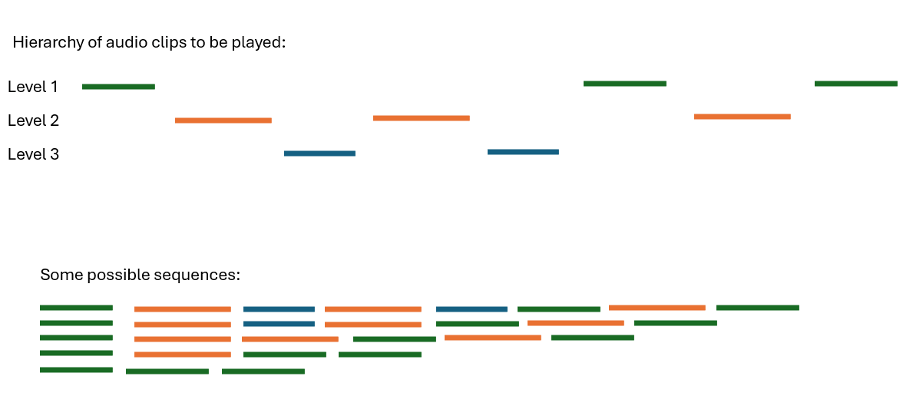
Audio clips are arranged in a hierarchical model of priority. Clips are dynamically selected based on the distance to waypoints.
Sensitizer:
Participants: Single user or shared group.
Breakdown:
- Hierarchical audio model
- Algorithm for converting current location into current depth
- Delivery mechanism for audio
Variations:
- Non-Linear: Instead of one route, multiple possible routes with a mechanism for playing the correct sequence based on which choice of route taken.
- Decoupled Location: There could be multiple location nodes that can be travelled to at any given moment, with audio sequences playing regardless of which next location is chosen.
Rationale
This works because the audio playback is adaptive to the user rather than requiring the user to adapt to the system. It keeps attention on environment rather than device, contributing to a sense of place.
Implementation Details
Suggestions:
- This can be achieved by tracking the user location and speed, and queuing up audio tracks based on a calculation of how much longer they have until they reach the end of the route or section of a route.
Issues:
- If a user moves quickly and then slowly they can hear less than someone moving at a steady pace, as earlier potential audio in the chronology would have been skipped over.
Pitfalls:
- Lots of additional content may be needed to fill out the audio model. The device needs to be switched on for the whole time, which can be tricky in some phone implementations. It is complex to test due to the wide variety of possible variations.
Impact on Immersion
Sensory
The focus of the user is away from their device, and they can be immersed in the landscape though not the wider soundscape.
Narrative
The user can be immersed in a story as they travel without stopping and starting of audio.
Ludic Considerations
- Writing could add more playful elements, surfacing the choice outcomes of speed of movement (e.g. “if you want to do x then stay here a while, otherwise hurry on to the next turning”).
Example
This technique was developed in the Tales of Flint audio app. Listeners to the experience in the app walk a route across the countryside around the Neolithic site of Avebury, taking between 45 minutes to an hour. They hear six historical monologues which are lengthened or abridged accordingly to match the pace of the listener.
More information is available here:
Code: Ages of Avebury is available from Github:
https://github.com/LoGaCulture/Ages-of-Avebury
4. Supplementary Information
Biography
v.1.0 20/03/26
v.2.0 23/03/26
Discussion
Success depends strongly on the device knowing where the user is going and correctly judging their pace. The ideal experience is a continual stream of audio, but this requires a great deal of potential content to draw from and in any case can always be exhausted if someone chooses to wait in place. The fluid nature of the audio can either be made clear to the user or remain a hidden part of the underlying experience.
Related Patterns:
- Skeuomorphism
Team
- Dr Jack Brett – Lead Engineer
- Dr Charlie Hargood – Academic Investigator and Architect
- Dr David Millard – Academic Investigator and Architect
- Dr Yoan Malinov – Engineer
- Dr Bob Rimmington – Qualitative Researcher
Partners

Related Resources
-
Directional Audio Navigation Cues
1. Overview Pattern Level: Sub-pattern of Audio-First Dual-Mode NavigationPrimary Phase: GuidingOne-line Summary: A navigation mechanism that plays periodic spatially positioned musical cues derived from each character’s theme, giving players directional…
-
Character-Triggered Layer Transition
1. Overview Pattern Level: High-levelPrimary Phase: Cross-phaseOne-line Summary: A layer switching mechanism that transitions the player to a different content layer when they complete an encounter with a designated portal…
-
Orientation-Based Combat
1. Overview Pattern Level: High-level Primary Phase: PresentingOne-line Summary: A challenge mechanic that uses head orientation tracking to let players evade spatially positioned threats, turning the same sensing infrastructure used for…
-
Head-Directed Target Locking
1. Overview Pattern Level: Sub-pattern of Audio-First Dual-Mode NavigationPrimary Phase: GuidingOne-line Summary: A target selection mechanism that locks onto a navigation target when the player maintains head orientation toward it…
-
Progressive Proximity Audio Zones
1. Overview Pattern Level: Sub-pattern of Audio-First Dual-Mode NavigationPrimary Phase: PresentingOne-line Summary: A zone-based audio system that transitions players from silence through character music to narrative dialogue as they physically…
-
Audio-First Dual-Mode Navigation
1. Overview Pattern Level: High-levelPrimary Phase: Cross-phaseOne-line Summary: A navigation system that automatically separates exploration and content delivery into two distinct modes, preventing navigation audio and character audio from competing…


