
1. Overview
Name
- Popular Name: Polyholomorphic Devices
- Alternative Names: Modes of Operation, Holistic Skeuomorphism, Polyholomorphism, polyholomorphic design
Intent
To clearly distinguish different modes of operation when using a device, by totally changing both its aesthetics and affordances in each mode, creating the illusion that the device has transformed from one thing into another.
Classification/Mapping
Operation: Behavioural
Primary Phase: Indicating
Underlying Principle: Immersion Pattern
Strength of evidence
Trialled, tested
2. Target
Problem
There are two (or more) specific tasks that need to be accomplished, that do not overlap and which need to be conceptually kept separate to make it clear to the user what the affordances are within each task – but there is only one device available.
Context
- Situation: The user is using a single device, and is moving from one task to another. The behaviour pattern they have come to expect from previous device interaction will be subverted. The user needs to clearly understand that the mode of operation is changing.
- Environment: N/A
Forces
The success of the pattern depends on:
- The distinctness and separation of the tasks
- The frequency and effort of switching modes (less frequently and lower effort are likely better)
- The ability of the device to change its interface and appearance
- The similarly of the device’s form to the form of the target device
Consequences
Weaknesses:
- W1 – The affordances of other modes are not clearly apparent to the user
- W2 – It adds a barrier to accessing affordances in another mode
- W3 – Compared to a combined device, the separate modes of operation act as a barrier to complex interactions between the tasks in each mode
- W4 – New and unexpected interface and user experience changes represent a barrier to fluid device use
Strengths:
- S1 – Creates focus on a specific task for the user
- S2 – Creates focus on a specific task for the designer
- S3 – Compared to two separate devices it is easier to enable interactions between the two modes
- S4 – Signals to the user a major change in expected use-case
3. Application
Solution
Sensitizer:
Participants: This is designed for a single participant.
Breakdown:
Software changes appearance and behaviour, transforming from one mode to another:
- Graphic or visual change
- Utility change
- User experience change
Variations:
- Skeuomorphic interfaces that draw on metaphors appropriate to the different contexts. However, polyholomorphic designs seek to go beyond metaphor toward a holistic behaviour and utility change. That is, the technology becoming the symbolised object rather than only showing the symbol.
- Context of use could be a cue that is tied to changes of mode of operation to make switches clear and obvious (for example, changing location)
- Software version changes within a single package e.g. Tomb Raider I-III Remastered (2024)
Rationale
Mode changes in a system sometimes benefit from being communicated through holistic transformation, in order to signal a change in use-expectations to the user.
Implementation Details
Suggestions:
- Polyholomorphism may be used to demonstrate changes in location (inter-culture or international), or temporality (e.g. version changes or past and future-gazing).
- Polyholomorphic design may be used as a framing device to delineate e.g. the movement from an A/B test environment to a feedback environment
Issues:
- Causes disruption to user experience and ‘flow’, which may produce friction and/or confusion.
- Onboarding and user guidance may be necessary when modes switch, if the user experience has changed to an extent to which their learned skills are no longer applicable.
Pitfalls:
- Polyholomorphic design should not be implemented at the cost of accessibility or usability
Impact on Immersion
Cultural Immersion: could be impacted by the aesthetics or functionality of each mode (enhanced if aligned with target cultures, detracts if misaligned).
Narrative Immersion: could be impacted by the relationship of the metaphorical devices and the switching action to the narrative. If it makes narrative sense for the player to have change modes, or have access to the metaphorical device within each mode, then it enhances, if not then it detracts.
Ludic Considerations
- Changing modes could be used as an element of surprise within an experience.
- If aligned with space or time, polyholomorphism can support narrative spaces by integrating interaction and appearance.
- Ludically, the change of modes supports clear separation of goals and abilities that may help players with sensemaking.
- Mode switching is a mechanic that could be used to support new dynamics in the game. (E.g. Deliberately selecting a mode to solve Puzzles, switching between hiding and running in Evade games).
Example
Known Uses:
‘Ages of Avebury’ (2025) implements polyholomorphism to communicate changes in time and culture, transforming a smartphone with a modern edutainment interface into a stone, or stone-like object. This is achieved through elimination of the majority of the user interface and a shift in both gameplay and user interface.
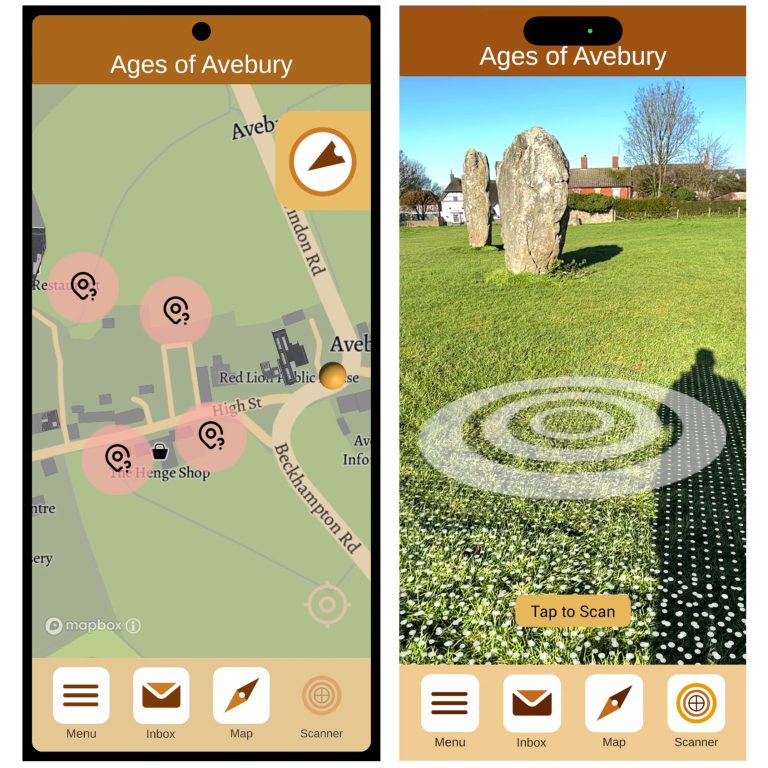
Ages of Avebury modern interfaces. Left-side shows a map with marked locations. Right-side shows an Augmented Reality ‘radar scanning’ interface. Both additionally offer options to show a menu, and an inbox.
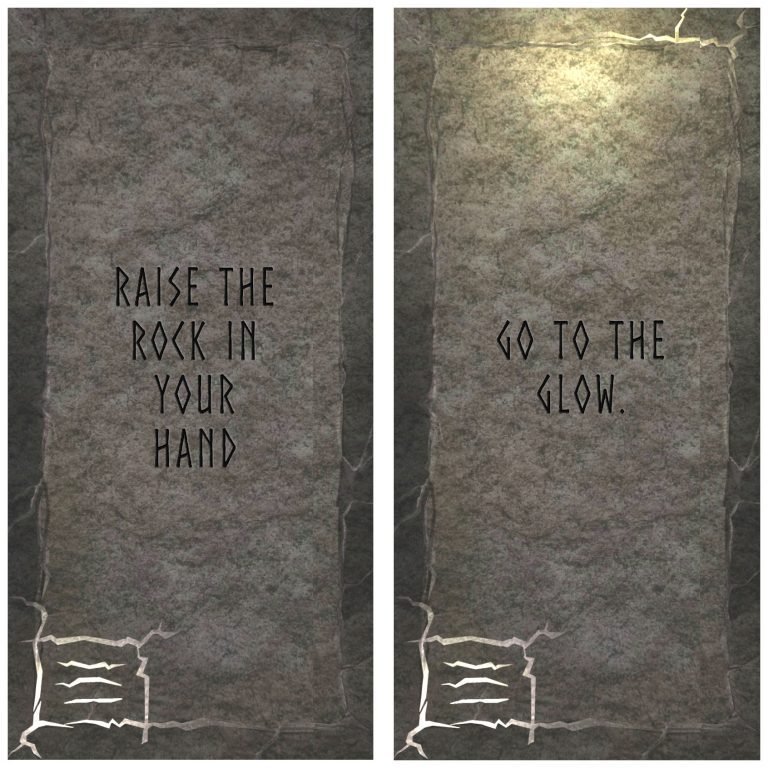
During the game, the player is transported through time. The Stone interfaces above demonstrate intentions to creating a stone-like interface and experience, by limiting interaction and diegetically referring to the device as a stone. A menu option, and subtitles, remain for accessibility.
More information is available here: https://logaculture.eu/case-study-1/
Code: Ages of Avebury is available from Github:
https://github.com/LoGaCulture/Ages-of-Avebury
4. Supplementary Information
Biography
Version 1.1 (18/03/26) – Completed based on publication and evaluation of ‘Ages of Avebury’ – Avebury Case Study 1 game deliverable.
Version 1.0 (8/10/24) – Extended based on current Avebury Case Study 1 design documents.
Version 0.9 (2/10/24) – Initial draft developed as part of the LoGaProject WP6, investigation into design and interaction patterns.
Discussion
Complexity: Applying polyholomorphism requires a significant increase in labour-hours compared to designing a single-mode application or interface.
Despite the mode and interaction changes that characterise polyholomorphism, it is not necessary for the difference in modes to be radical in order for the benefit to be felt. Indeed, it may be helpful to seek to make the distance between modes smaller for ease of use. This may be achieved by maintaining consistency in interaction design to align with expectations, even where the interface has transformed. E.g. in the example of Ages of Avebury, above, the menu icon retains its position and symbol across transformations.
Related Patterns:
- Skeuomorphism
Team
- Dr Jack Brett – Lead Engineer
- Dr Charlie Hargood – Academic Investigator and Architect
- Dr David Millard – Academic Investigator and Architect
- Dr Yoan Malinov – Engineer
- Dr Bob Rimmington – Qualitative Researcher
Partners

Related Resources
-
Directional Audio Navigation Cues
1. Overview Pattern Level: Sub-pattern of Audio-First Dual-Mode NavigationPrimary Phase: GuidingOne-line Summary: A navigation mechanism that plays periodic spatially positioned musical cues derived from each character’s theme, giving players directional…
-
Character-Triggered Layer Transition
1. Overview Pattern Level: High-levelPrimary Phase: Cross-phaseOne-line Summary: A layer switching mechanism that transitions the player to a different content layer when they complete an encounter with a designated portal…
-
Orientation-Based Combat
1. Overview Pattern Level: High-level Primary Phase: PresentingOne-line Summary: A challenge mechanic that uses head orientation tracking to let players evade spatially positioned threats, turning the same sensing infrastructure used for…
-
Head-Directed Target Locking
1. Overview Pattern Level: Sub-pattern of Audio-First Dual-Mode NavigationPrimary Phase: GuidingOne-line Summary: A target selection mechanism that locks onto a navigation target when the player maintains head orientation toward it…
-
Progressive Proximity Audio Zones
1. Overview Pattern Level: Sub-pattern of Audio-First Dual-Mode NavigationPrimary Phase: PresentingOne-line Summary: A zone-based audio system that transitions players from silence through character music to narrative dialogue as they physically…
-
Audio-First Dual-Mode Navigation
1. Overview Pattern Level: High-levelPrimary Phase: Cross-phaseOne-line Summary: A navigation system that automatically separates exploration and content delivery into two distinct modes, preventing navigation audio and character audio from competing…


